Professional ICP Testing for Saltwater Aquariums
ICP-OES Used to Analyze Over 35 Elements
Water Analysis Performed by Professional & Qualified Personnel
Progress Display for Each Aquarium on the lab.tropic-marin.com Website
Dosing Recommendations to Correct Any Imbalances
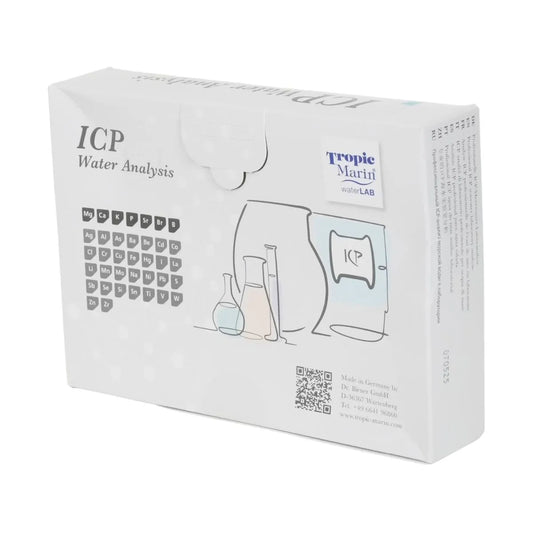
The Tropic Marin ICP Water Analysis provides professional-grade laboratory testing for your aquarium water. Each sample is analyzed using ICP-OES to measure the concentration of more than 35 elements. Testing is performed by qualified laboratory personnel to ensure accuracy and reliability.
After your water is analyzed, you’ll receive a detailed report on lab.tropic-marin.com. Results include dosing recommendations to correct any imbalances, along with a convenient progress display showing your aquarium’s results over time.
Deficiencies can be addressed using Tropic Marin Block multi-element solutions or Tropic Marin Components single-element additives.
Tropic Marin ICP Water Analysis vs. Tropic Marin ICP Water Analysis Plus
Standard ICP Water Analysis (Currently Viewing): The Tropic Marin ICP Water Analysis evaluates over 35 elements, including:
Major elements: Magnesium (Mg), Calcium (Ca), Potassium (K), Sodium (Na), Sulfur (S), Phosphorus (P), Chlorine (Cl)
Minor elements: Strontium (Sr), Boron (B), Iodine (I), Iron (Fe), Manganese (Mn), Lithium (Li), Silicon (Si), Bromine (Br)
Trace and heavy metals: Zinc (Zn), Copper (Cu), Nickel (Ni), Lead (Pb), Chromium (Cr), Cobalt (Co), Molybdenum (Mo), Vanadium (V), Titanium (Ti), Tin (Sn), Arsenic (As), Selenium (Se), Antimony (Sb), Silver (Ag), Barium (Ba), Beryllium (Be), Cadmium (Cd), Mercury (Hg), Lanthanum (La), Tungsten (W), Zirconium (Zr), Aluminum (Al)
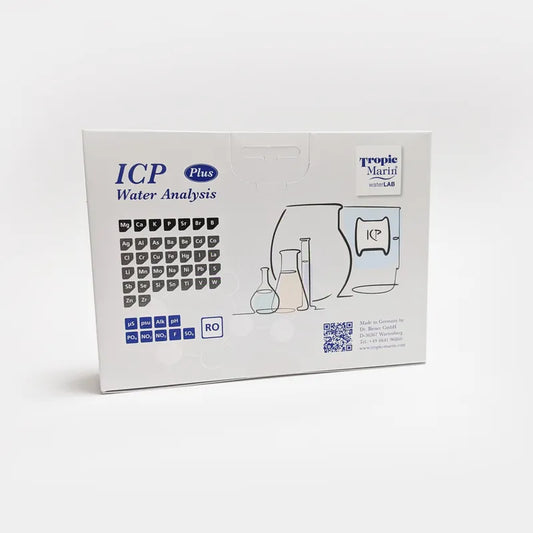
ICP Water Analysis Plus: Includes everything from the standard test, but also measures additional parameters like Microsiemens (µS), Practical Salinity Units (psu), Alkalinity (Alk), Potential of Hydrogen (pH), Phosphate (PO₄), Nitrite (NO₂), Nitrate (NO₃), Fluoride (F), Sulfate (SO₄), Reverse Osmosis Water Quality (RO).
How to Send in Your Sample
Register on the website lab.tropic-marin.com and create your aquariums.
Register your water sample with the individual sample number (in the packaging) on the website. To do this, go to the website and enter the number code under “new sample”. Alternatively, simply scan the QR code on the label with the sample number. This step is very important: without registering the sample, the water sample sent in cannot be assigned and you will not receive a result.
Rinse the cuvettes several times with aquarium or osmosis water.
Take two water samples one after the other using the syringe provided. Squeeze the first 10 ml of water back into the aquarium through the syringe filter and then squeeze the remaining 15 ml into the cuvettes and seal them.
Stick a label with the sample number on each cuvette.
Stick the address label on the packaging box and send the water samples to the specified address.
You will be informed by e-mail when the analysis is complete. You can call up the results as a PDF or display them online. In the latter case, a history of the water values for each aquarium is also displayed.
What's Included?
Tropic Marin ICP Water Analysis Kit (Available in Single Test, 3 Pack, or 6 Pack)
Each Kit Includes:
2 Empty Cuvettes
1x Syringe
Syringe Filter
Label with Sample Numbers and Return Address
Here is where reef aquarium biology, chemistry, and technology meet, combined with the most intellectual, easy-to-read website you will ever find. Our website system will solve any anomaly and guide you to a better result based on your reef aquarium. In other words, our water analysis is meant to fix a problem and achieve goals based on your aquarium setup, equipment used, reef aquarium type, and the water analysis results. Our system will find a “correction” dosage for parameters, maintenance dosage for elements, pollutants and help you decide if your equipment or products should be stopped or added to your reef aquarium. Our intelligent system also offers a help section called “Anomalies”, with multi-task semi-automated management to keep track of all your tasks suggested by our lab. We can test for up to 56 parameters, including KH, high-resolution salinity test, nutrients, pollutants, and water clarity, to take the most advantage of your illumination, only offered by Modern Reef Lab. Our two extensive laboratories comprise more than ICP MS/OES machines; we use chromatography and other modern laboratory equipment and methods to back up results. We can deliver water analysis results within 24 hours thanks to several machines per method. You also have the option to track the status of your sample online and scan your QR code to avoid typing mistakes. Our laboratory is operational 24/7 to ensure fast results, and we consider all our samples to be priority number one without an additional cost. This set includes RO/DI water analysis.
Key Features
AI Analyst Quality Control:Advanced AI-powered Analyst acts as a third level of quality control, ensuring unmatched accuracy, consistency, and reliability in every water analysis report.
Comprehensive Water Analysis:Assess up to 56 critical parameters—including salinity, alkalinity (KH), pH, calcium, magnesium, nutrients, pollutants, and water clarity—to provide a complete snapshot of your reef system’s health. Includes osmosis (RO/DI) water sample analysis covering 49 essential parameters.
Intelligent Recommendation Engine:Cutting-edge online system analyzes your unique results and delivers personalized, actionable guidance tailored to your aquarium’s setup, equipment, and objectives.
Goal-Oriented Corrections:Instantly receive precise recommendations for correction dosages, ongoing maintenance, and product or equipment adjustments—all customized to your water analysis outcomes.
Anomaly Management:Built-in Anomalies section with semi-automated task management lets you resolve issues and track lab-suggested actions efficiently.
Advanced Laboratory Technology:Dual, state-of-the-art laboratories equipped with ICP-OES/MS base, chromatography, and other modern analytical methods for uncompromised precision.
Rapid Turnaround—Always a Priority:Comprehensive water analysis results delivered within 24 hours. Our labs operate 24/7, treating every sample as a top priority, at no extra cost.
Effortless Sample Tracking:Monitor your sample status in real time online, and submit samples easily with QR code scanning for error-free, streamlined processing.
User-Friendly Digital Experience:Access the most intellectually-driven, easy-to-read website in the industry, featuring clear navigation, expert guidance, and educational resources for every reef aquarist.
56 parameters (Reef Water ICP only Analysis)
SALINITY (PSU, SG, mS/cm), Kh, pH, CO2, WATER CLARITY (MRNU), PAR LOSS (PARL), Ca, Cl, B, Br, K, Mg, F, Na, S, Sr, Ba, Co, Cr, Cu, Fe, I, Li, Mn, Mo, Ni, Se, V, Zn, No3, P, Po4, Si, Al, As, Ag, Be, Bi, Cd, Ga, Ge, Hg, La, In, Nb, Pb, Sb, Sc, Sn, Te, Ti, Tl, W, Zr.
49 parameters (RO/DI Water Analysis)
SALINITY (PSU), Ca, Cl, B, Br, K, Mg, F, Na, S, Sr, Ba, Co, Cr, Cu, Fe, I, Li, Mn, Mo, Ni, Se, V, Zn, No3, P, Po4, Si, Al, As, Ag, Be, Bi, Cd, Ga, Ge, Hg, La, In, Nb, Pb, Sb, Sc, Sn, Te, Ti, Tl, W, Zr
N-DOC Lab Testing
Deliver insights into complex organic systems in seawater: Carbon and NitrogenUse the TRITON Ratio (N:C:P*) to manage sources of nutrients and control their influence on corals, bacteria and algae in reef aquaria.(*Note: P value measured separately via recent ICP test or manually)Eliminate problems caused by blind dosingUse for problem solving and determining the need for corrective water changesTrouble shoot common problems such as tissue necrosis, nuisance bacteria and algae blooms and cyanobacteriaMeasure true Alkalinity, free from external influences
Know what is in your water!
Why Does BRS Recommend This?
We have been utilizing Triton's ICP-OES testing system for some time with aquariums, additives, and almost any other liquid that we have wanted to know what is in it exactly. Triton now gives you the ability to know what is in your reef tank and even better, how to fix it! Many additive systems just tell you to add a couple capfuls every day, and we all know that isn't the best method of reefing. Triton uses accurate testing to analyze the concentration of elements within your tank, and with their research and additives, they even let you know how to get your reef tank back on track.
Triton ICP-OES testing will provide you with a detailed analysis for 36 different elements with extreme accuracy.
Higher levels of success
Tested at USA Triton Lab
Just fill the vials and send it in
Know what is missing/excessive and how to fix it
What Is Triton Testing?
Triton ICP-OES (Inductively Coupled Plasma-Optical Emission Spectrometry) testing is done using plasma that is heated to 10,000 degrees Kelvin and will literally rip molecules apart giving the most accurate saltwater aquarium test results available. Traditionally most testing on reef tanks is done with hobby grade, low-cost test kits, that are notorious for being inaccurate and hard to discern. Triton testing gives you precise views into 36 different elements that are very important to overall coral health and vitality.
Triton analyzes a comprehensive suite of macro and trace elements crucial to healthy function of your reef system:Sodium (Na), Calcium (Ca), Magnesium (Mg), Potassium (K), Strontium (Sr), Boron (B), Bromine (Br), Sulphur (S), Lithium (Li), Beryllium (Be), Barium (Ba), Titanium (Ti), Vanadium (V), Chromium (Cr), Manganese (Mn), Iron (Fe), Cobalt (Co), Nickel (Ni), Copper (Cu), Zinc (Zn), Aluminium (Al), Silicon (Si), Arsenic (As), Antimony (Sb), Tin (Sn), Cadmium (Cd), Selenium (Se), Molybdenum (Mo), Mercury (Hg), Phosphorus (P), Phosphate (PO4), Lead (Pb), Iodine (I), Tungsten (W), Scandium (Sc), Lanthanum (La).
Why Use Triton Testing?
Knowing the elemental concentration in your reef tank is very important, and traditionally a large water change was done once every 6 months to a year to help alleviate the possibility of molecule and element build up in the water. Using Triton ICP testing lets you know what is right, what is excessive, what is missing, and how to fix it all. After sending in your Triton test you will receive a detailed analysis of what is in your reef, and how you should react.
We highly recommend a minimum of 3 tests for your first time so you can establish a "baseline" reading for your reef with a second test to track any adjustments made after the initial test, and then the third test is used to determine what trace elements are being consumed at a higher rate than others after the initial adjustments.
Triton ICP-OES Testing is done in California. After performing your test, you must mail your samples to the address provided with the test kit. A return postage label is included. Your test ships free via USPS First-Class to the US-based Triton Lab. In most cases, results will be accessible within 24-48 hours after receipt at the Triton Lab.
Instructions
1. Visit triton-labs website and register an account.
2. Inside of the test kit, there will be a barcode that you will need to connect the test kit to the account you just created.
3. Collect a sample of water from your aquarium both test vials with aquarium water three times, then filling each vial completely.
4. Place the barcodes on each vial and then put them both into the return shipping box.
5. Remove the protective film from the sticky tape and seal the box.
6. Place included return label on the package and place it in your mailbox or bring it to your local Post Office.
7. You will then start to receive email updates when the sample is received, and also when the test is completed.
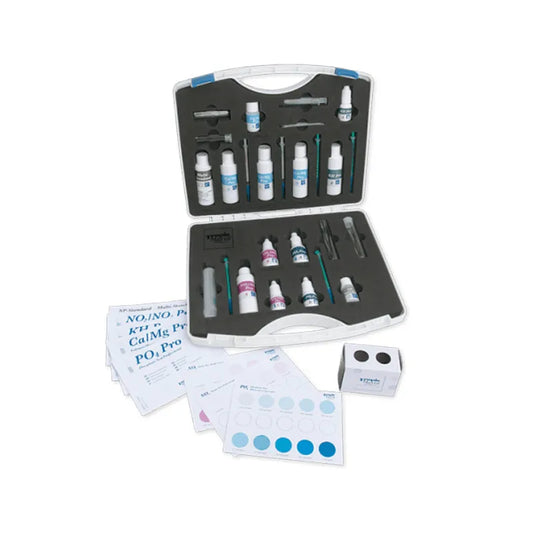
Tropic Marin Professional Lab is a complete test kit for monitoring water values in marine aquariums. It contains highly precise tests for phosphate, nitrite, nitrate, calcium, magnesium, and carbonate hardness. Reference solutions for Multi-Standard and NP-Standard, as well as illustrated instruction manuals, are also included.
Features
Comprehensive saltwater testing in a handy, organized case
Contains tests for calcium, magnesium, KH/alkalinity, phosphate, nitrite & nitrate
Enough for approximately 50 applications
As soon as reagents are exhausted, the Professional Lab kit can be easily refilled with Tropic Marin Refill Packs.
What’s Included?
1 x Pro Calcium/Magnesium Test (50 individual tests)
1 x Pro KH Test (50 individual tests)
1 x Pro Nitrite/Nitrate Test (50 individual tests)
1 x Pro Phosphate Test (50 individual tests)
1 x Multi-Standard Solution
1 x NP-Standard Solution
Here is where reef aquarium biology, chemistry, and technology meet, combined with the most intellectual, easy-to-read website you will ever find. Our website system will solve any anomaly and guide you to a better result based on your reef aquarium. In other words, our water analysis is meant to fix a problem and achieve goals based on your aquarium setup, equipment used, reef aquarium type, and the water analysis results. Our system will find a “correction” dosage for parameters, maintenance dosage for elements, pollutants and help you decide if your equipment or products should be stopped or added to your reef aquarium. Our intelligent system also offers a help section called “Anomalies”, with multi-task semi-automated management to keep track of all your tasks suggested by our lab. We can test for up to 56 parameters, including KH, high-resolution salinity test, nutrients, pollutants, and water clarity, to take the most advantage of your illumination, only offered by Modern Reef Lab. Our two extensive laboratories comprise more than ICP MS/OES machines; we use chromatography and other modern laboratory equipment and methods to back up results. We can deliver water analysis results within 24 hours thanks to several machines per method. You also have the option to track the status of your sample online and scan your QR code to avoid typing mistakes. Our laboratory is operational 24/7 to ensure fast results, and we consider all our samples to be priority number one without an additional cost.
Key Features
AI Analyst Quality Control:Advanced AI-powered Analyst acts as a third level of quality control, ensuring unmatched accuracy, consistency, and reliability in every water analysis report.
Comprehensive Water Analysis:Assess up to 56 critical parameters—including salinity, alkalinity (KH), pH, calcium, magnesium, nutrients, pollutants, and water clarity—to provide a complete snapshot of your reef system’s health.
Intelligent Recommendation Engine:Cutting-edge online system analyzes your unique results and delivers personalized, actionable guidance tailored to your aquarium’s setup, equipment, and objectives.
Goal-Oriented Corrections:Instantly receive precise recommendations for correction dosages, ongoing maintenance, and product or equipment adjustments—all customized to your water analysis outcomes.
Anomaly Management:Built-in Anomalies section with semi-automated task management lets you resolve issues and track lab-suggested actions efficiently.
Advanced Laboratory Technology:Dual, state-of-the-art laboratories equipped with ICP-OES/MS base, chromatography, and other modern analytical methods for uncompromised precision.
Rapid Turnaround—Always a Priority:Comprehensive water analysis results delivered within 24 hours. Our labs operate 24/7, treating every sample as a top priority, at no extra cost.
Effortless Sample Tracking:Monitor your sample status in real time online, and submit samples easily with QR code scanning for error-free, streamlined processing.
User-Friendly Digital Experience:Access the most intellectually-driven, easy-to-read website in the industry, featuring clear navigation, expert guidance, and educational resources for every reef aquarist.
56 parameters (Reef Water ICP only Analysis)
SALINITY (PSU, SG, mS/cm), Kh, pH, CO2, WATER CLARITY (MRNU), PAR LOSS (PARL), Ca, Cl, B, Br, K, Mg, F, Na, S, Sr, Ba, Co, Cr, Cu, Fe, I, Li, Mn, Mo, Ni, Se, V, Zn, No3, P, Po4, Si, Al, As, Ag, Be, Bi, Cd, Ga, Ge, Hg, La, In, Nb, Pb, Sb, Sc, Sn, Te, Ti, Tl, W, Zr.
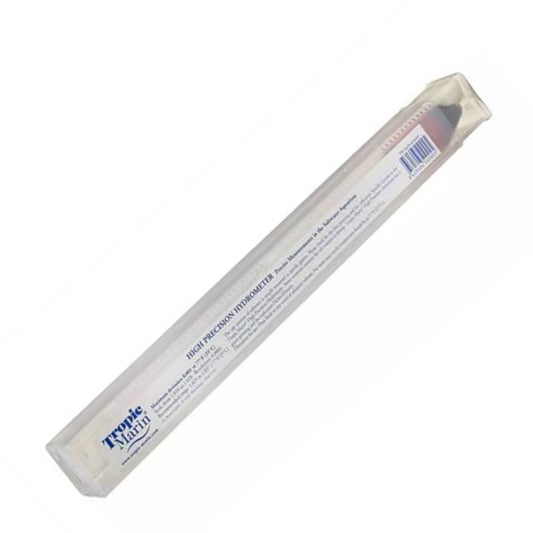
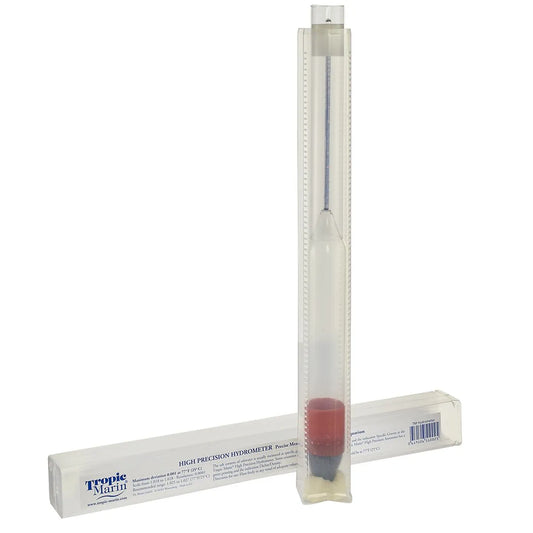
Ensure that your equipment is reading correctly and your aquarium is at the right salinity with Tropic Marin's High Precision Hydrometer.
Many tank inhabitants are sensitive even to minor changes of the water conditions. Unfortunately as we've all experienced, salinity reading equipment as well as calibration solutions can drift over time and it can occasionally be a challenge to ensure equipment is always calibrated correctly. That's where the Tropic Marin Hydrometer comes in. The Tropic Marin High Precision Hydrometer provides an exact and reliable measurement of specific gravity, and it never needs to be re-calibrated, so it's a perfect reference device for calibrating other equipment.
High precision hydrometer for determining the specific gravity in aquariums
Maximum deviation: 0.001 at 77° F (25° C)
Scale from 1.021 to 1.031
Resolution: 0.0001
Handmade
The hydrometer is handmade and designed to float vertically in the water. The maximum deviation is about 0.001 at 77° F (25° C).
Please note: The salt content of sea water is usually measured as specific gravity. Please check for the blue printing and the indication “Specific Gravity” at the Tropic Marin High Precision Hydrometer.
Ensure that your equipment is reading correctly and your aquarium is at the right salinity with Tropic Marin's High Precision Hydrometer.
Many tank inhabitants are sensitive even to minor changes of the water conditions. Unfortunately as we've all experienced, salinity reading equipment as well as calibration solutions can drift over time and it can occasionally be a challenge to ensure equipment is always calibrated correctly. That's where the Tropic Marin Hydrometer comes in. The Tropic Marin High Precision Hydrometer provides an exact and reliable measurement of specific gravity, and it never needs to be re-calibrated, so it's a perfect reference device for calibrating other equipment.
High precision hydrometer for determining the specific gravity in aquariums
Maximum deviation: 0.001 at 77° F (25° C)
Scale from 1.021 to 1.031
Resolution: 0.0001
Handmade
The hydrometer is handmade and designed to float vertically in the water. The maximum deviation is about 0.001 at 77° F (25° C).
Please note: The salt content of sea water is usually measured as specific gravity. Please check for the blue printing and the indication “Specific Gravity” at the Tropic Marin High Precision Hydrometer.
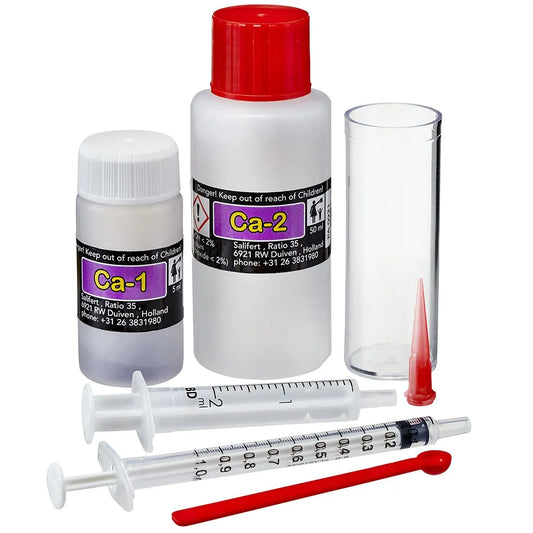
rusted by discerning reefers for years, Salifert Test Kits feature some of the easiest to read results available. Their test kits include easy to follow instructions and straightforward, accurate results. Salifert test kits are also some of the most economical; the Salifert Calcium Test Kit will typically deliver upwards of 50 tests per kit.
Note: Calcium Test kit is rated for 50-100 tests. The actual number of tests a kit will deliver varies based on calcium levels and the amount of reagent required to reach the endpoint of the test, but we have typically gotten about 50 tests with common reef tank calcium levels.
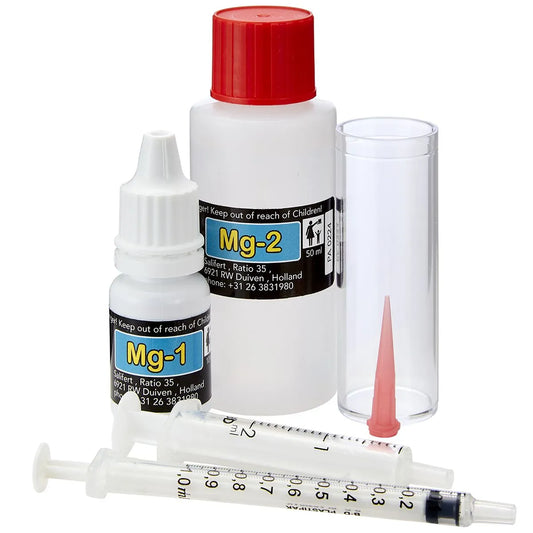
Get accurate, easy to read magnesium results in minutes!
Trusted by discerning reefers for years, Salifert Test Kits feature some of the easiest to read results available. Their test kits include easy to follow instructions and straightforward, accurate results. Salifert test kits are also some of the most economical; the Salifert Magnesium Test Kit will typically deliver 50 tests per kit.
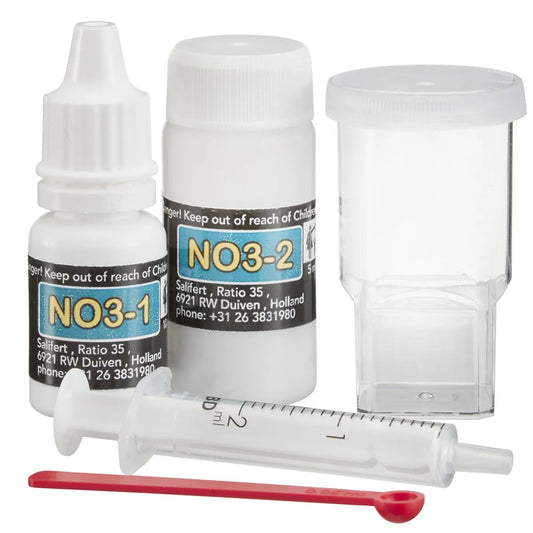
Get accurate, easy to read nitrate test results in minutes!
Trusted by discerning reefers for years, Salifert Test Kits feature some of the easiest to read results available. Their test kits include easy to follow instructions and straightforward, accurate results. Salifert test kits are also some of the most economical; the Salifert Nitrate Test Kit will typically deliver 60 tests per kit.
Get accurate, easy to read phosphate test results in minutes!
Trusted by discerning reefers for years, Salifert Test Kits feature some of the easiest to read results available. Their test kits include easy to follow instructions and straightforward, accurate results. Salifert test kits are also some of the most economical; the Salifert Phosphate Test Kit will typically deliver 60 tests per kit.
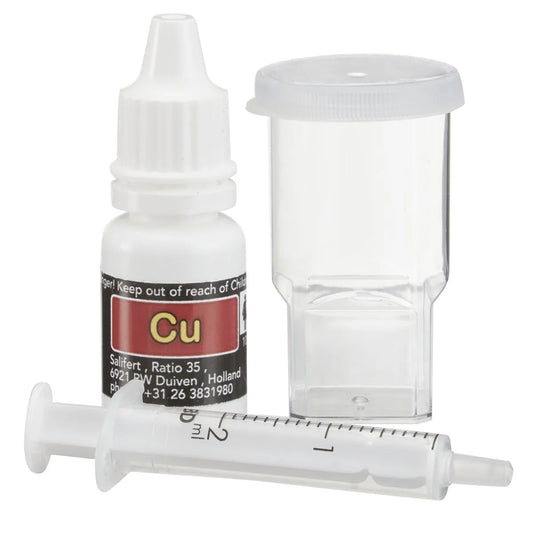
Get accurate, easy to read copper test results in minutes!
Trusted by discerning reefers for years, Salifert Test Kits feature some of the easiest to read results available. Their test kits include easy to follow instructions and straightforward, accurate results. Salifert test kits are also some of the most economical; the Salifert Copper Test Kit will typically deliver 50 tests per kit.
Test Range: 0.05 to 2.0 ppm
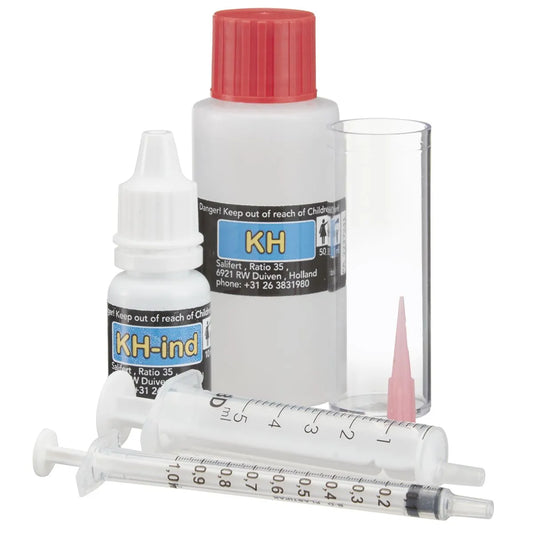
Easily test the kH/Alkalinity level in your tank. Trusted by discerning reefers for years, Salifert Test Kits feature some of the easiest to read results available to each testing method. The Salifert kH/Alkalinity Test Kit contains 100-200 (typically closer to 100) tests.
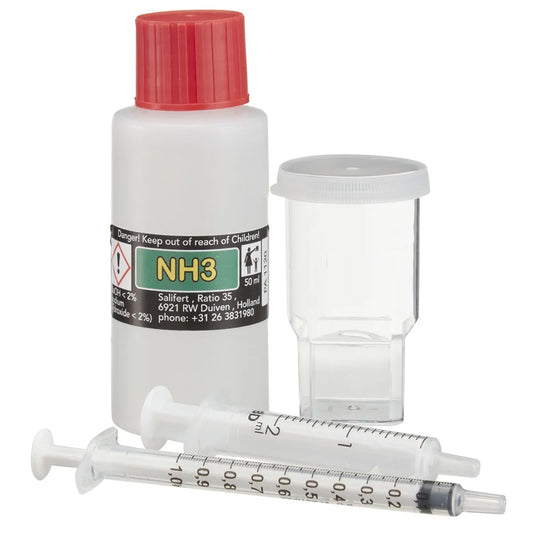
Get accurate, easy to read ammonia test results in minutes!
Trusted by discerning reefers for years, Salifert Test Kits feature some of the easiest to read results available. Their test kits include easy to follow instructions and straightforward, accurate results. Salifert test kits are also some of the most economical; the Salifert Ammonia Test Kit contains 50 tests per kit and can easily detect as low as 0.5 ppm of total ammonia.
One Set - 5 Parameters - Over 250 Tests!
100 pH Tests
100 Alkalinity Tests
50 Phosphate Tests
50 Nitrite/Nitrate Tests
50 Ammonium/Ammonia Tests
Being able to make quick and precise water quality assessments is vital and Tropic Marin Compact Lab Essentials Test Kit includes the necessary test kits every professional reefer needs.
Instructions:
pH - Up to 100 Tests
Shake the dropper bottle before use!
Rinse out the glass cuvette with tap water and then several times with aquarium water.
Fill the glass cuvette with exactly 5 ml of aquarium water using the dosing syringe.
Add 1 drop of pH test reagent, close the glass cuvette using the stopper and briefly shake the solution.
Place the glass cuvette on the white inner circles of the color card and compare it to the surrounding color fields. To do this, look into the open cuvette from above.
Read off the measured pH value under the relevant color field.
Rinse out the glass cuvette and the syringe thoroughly with tap water after the measurement process.
Alkalinity/dKH - Up to 100 Tests
Shake the dropper bottle before use!
Rinse out the glass cuvette with tap water and then several times with aquarium water.
Fill the glass cuvette with exactly 5 ml of aquarium water using the dosing syringe.
Now add the KH test reagent drop by drop (shake the cuvette after each drop), until the color of the solution changes from TURQUOISE to PINK.
The number of drops indicates the alkalinity of the solution in dKH, e.g. 8 drops = 8 dKH. To increase the accuracy of the measurement, a 10 ml water sample (instead of 5 ml) can be used. In that case, 1 drop corresponds to 0.5 dKH, i.e. 15 drops = 7.5 dKH.
Rinse out the glass cuvette and the syringe thoroughly with tap water after the measurement process
Phosphate/PO4 - Up to 50 Tests
Shake the dropper bottles before use! Assemble and prepare the comparator.
Rinse out both glass cuvettes with tap water and then several times with aquarium water.
Fill each glass cuvette with exactly 5 ml of aquarium water using the dosing syringe. Put one of the two water samples aside as a reference.
Add 10 drops (for saltwater) or 12 drops (for freshwater) of test reagent A to the test cuvette, close the glass cuvette using the stopper and briefly shake the sample.
After that, add 4 drops of test reagent B, close the glass cuvette once again and briefly shake it.
After 2 minutes of development time place the open test cuvette and the reference cuvette with the water sample into the comparator. Place the comparator on the color card in such a way that the reference cuvette is sitting on a colored field and the test cuvette on a white field.
Now compare the opposing fields. To do this, look into the open cuvettes from above. Move the comparator on the color card until both cuvettes match exactly.
Read off the phosphate concentration under the relevant color field. If the colors do not match exactly, an intermediate value can be estimated.
Rinse out the glass cuvettes and the syringe thoroughly with tap water after the measurement process.
Nitrite/Nitrate - Up to 50 Tests
Determining the nitrite level:
Shake the dropper bottles before use!
Rinse out the glass cuvette with tap water and then several times with aquarium water.
Fill the glass cuvette with exactly 5 ml of aquarium water using the dosing syringe.
Add 5 drops of test reagent A, close the glass cuvette using the stopper and briefly shake the solution.
Add 2 drops of test reagent C, close the glass cuvette once again and briefly shake it.
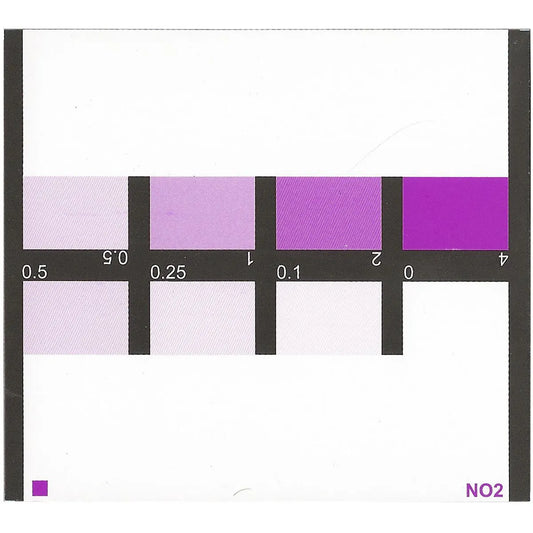
After 3 minutes of development time, place the glass cuvette on the white circles of the nitrite color card and compare it to the opposing color fields by daylight conditions. To do this, look into the open cuvette from above. Move the sample on the color card until the cuvette and the color field match exactly. If the colors do not match exactly, an intermediate value can be estimated.
Read off the measured nitrite value under the relevant color field.
Determining the nitrate level:
Shake the dropper bottles before use!
Rinse out the glass cuvette with tap water and then several times with aquarium water.
Fill the glass cuvette with exactly 5 ml of aquarium water using the dosing syringe.
Add 10 drops of test reagent A, close the glass cuvette using the stopper and briefly shake the solution.
Shake the bottle with test reagent B vigorously in a horizontal direction for approx. 30 seconds (the reagent must be well-shaken). Then add 10 drops of test reagent B, close the cuvette again, shake it briefly and set it aside.
After 3 minutes of development time, add 4 drops of test reagent C, close the glass cuvette once again and briefly shake it.
After another 3 minutes of development time, open the test cuvette and place it on the white circles of the nitrate color card and compare it to the opposing color fields by daylight conditions. To do this, look into the open cuvette from above. Move the sample on the color card until the cuvette and the color field match exactly. If the colors do not match exactly, an intermediate value can be estimated.
Read off the measured nitrate value under the relevant color field. Correct the result if necessary.
Rinse out the glass cuvette and the syringe thoroughly with tap water after the measurement process.
Ammonia - Up to 50 Tests
Determining the total concentration of ammonium/ammonia:
Shake the dropper bottles before use!
Rinse out the glass cuvette with tap water and then several times with aquarium water.
Fill the glass cuvette with exactly 5 ml of aquarium water using the dosing syringe.
Now add 10 drops of test reagent A to the water sample, close the glass cuvette using the stopper and briefly shake the solution.
Then add 5 drops of test reagent B to the test cuvette; shake the glass cuvette briefly again and set it aside.
After approx. 1 minute of development time, add 1 spoonful of test reagent C (powder), shake the glass cuvette briefly and then set it aside.
After 5 minutes of development time, place the glass cuvette on the white inner circles of the color card and compare it to the surrounding color field. To do this, look into the open cuvette from above. Move the sample on the color card until the cuvette and the color field match exactly. A slight cloudiness in the salt water sample will not affect the result of the test.
Take note of the measured total concentration value under the relevant color field. If the colors do not match exactly, an intermediate value can be estimated.
Rinse out the glass cuvette and the measuring spoon thoroughly with tap water after the measurement process.
What's Included?
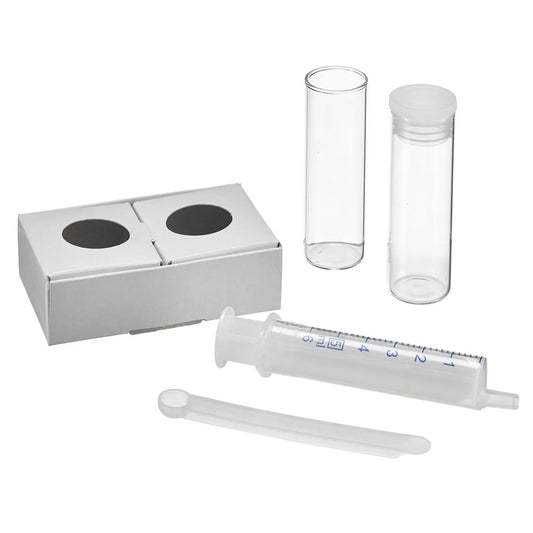
2x Test Vials
1x Syringe
1x Measuring Spoon
Individual Color Instructions
1x Reagent A Phosphate
1x Reagent B Phosphate
1x Reagent A NO2/NO3
1x Reagent B NO2/NO3
1x Reagent C NO2/NO3
1x Reagent A Ammonia
1x Reagent B Ammonia
1x Reagent C Ammonia
1x Reagent A Alkalinity
1x Reagent A pH
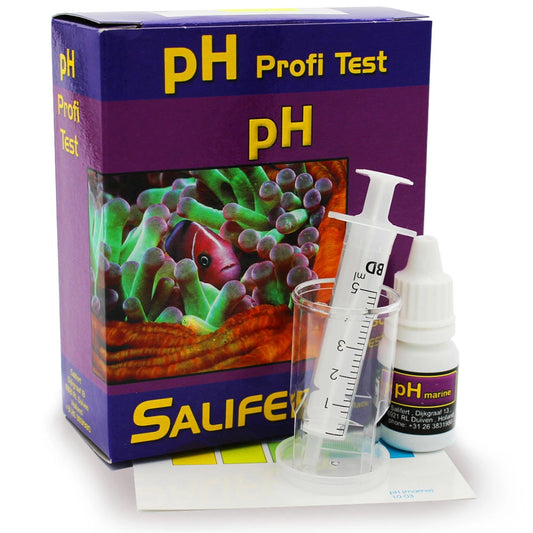
If the pH is too low then the cause may be a too low alkalinity and/or insufficient aeration. A low pH can be corrected by improving aeration and by increasing the alkalinity to NSW (Natural seawater) value or upto approx 25% above NSW levels. The Salifert pH test kit is sufficiently accurate to monitor pH fluctuations of approx 0.2 pH units. Our KH + pH Buffer allows fast and efficient correction of alkalinity. Approx. 50 tests per kit. Range pH 7.4 - 8.6. The pH value can have a major impact on the growth of corals and calcareous algae and on many biological processes. The pH should not be allowed to fluctuate more than approx. 0.3 units during 24 hours and should preferably be kept between 8.0 and 8.2.
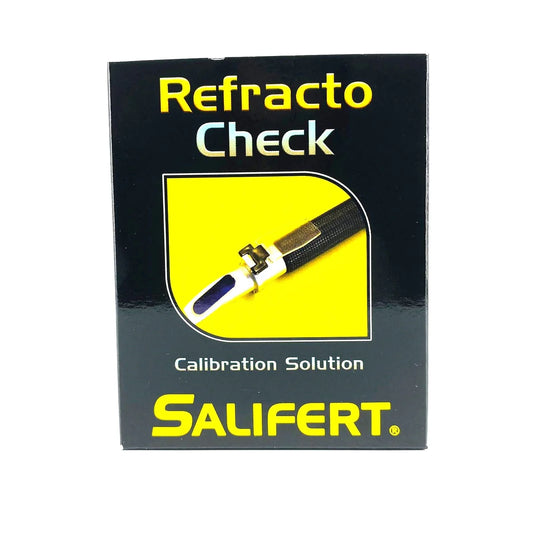
Salifert Refract Check Solution (10mL)35 0/00 solution for refractometers only.
Instructions:Before each use, shake the bottle, remove and salt scale from the nozzle, and discard the first 3 drops. Cap the bottle tightly after each use otherwise the value will increase tdue to evaporation.
Note:Keep out of the reach of children! Only for aquarium hobby use.The use of protective gloves and eye protection is recommended.Please read the instructions carefully before using the product.
Salifert:Salifert is a Netherlands base company that produces top of the line test kits as well as tank additives and foods for marine and reef aquariums. Salifert is well established and popular with hobbyist for their accurate and affordable test kits.
Get accurate, easy to read nitrite test results in minutes!
Trusted by discerning reefers for years, Salifert Test Kits feature some of the easiest to read results available. Their test kits include easy to follow instructions and straightforward, accurate results. Salifert test kits are also some of the most economical; the Salifert Nitrite Test Kit will typically deliver 60 tests per kit.
Get accurate, easy to read strontium test results in minutes!
Trusted by discerning reefers for years, Salifert Test Kits feature some of the easiest to read results available. Their test kits include easy to follow instructions and straightforward, accurate results. Salifert test kits are also some of the most economical; the Salifert Strontium Test Kit will typically deliver 25 tests per kit.
Having a reliable and easy to use potassium test kit is hard to come by. Salifert test kits have been trusted by discerning reefers for years for their ease of use and reliability. Many other test kits are hard to use and consume your valuable time. The average test using this kit should easily take under 5 minutes and give you a reading that can be repeated time and time again.
Contains up to 40 potassium tests.
If you are dosing potassium, the ability to monitor and measure how much you are adding is invaluable. Potassium levels in natural seawater is normally around 400 ppm. Many reefers will report loss of coloration in corals when potassium level start to drop below 360 ppm.
Instructions
Notes:
Before commencing with each test, it is very important to clean the nozzle (including the tip) of the K-3 dropper bottle with a paper tissue. Even if the nozzle looks clean and dry. Do this by applying a slight pressure on the tissue while cleaning.
Do NOT put the cap back on the K-3 bottle until the test has been completed.
An extra testing vial is included with the kit for convenience and only a one vial is needed for a single test. That lets you to use one vial while the other is being cleaned. With potassium test kits it is important to keep reagent tips, syringes and testing vials clean for reliable readings.
Holding the reagent bottle directly vertical will allow for even and consistent drops making readings reliable and repeatable.
Steps
With the unlabeled syringe add 1mL of aquarium water to the test vial. There will be a small air bubble (approx. 0.05 mL) in the syringe do NOT attempt to remove the air bubble.
Add 0.5 mL of K-1 using the red labeled syringe in the test vial. There will be a small air bubble (approx. 0.05 mL) in the syringe do NOT attempt to remove the air bubble. Swirl the test vial gently for at least 20 seconds.
Add to the test vial 3 drops of K-2 while holding the dropper bottle in a vertical position. There is no need to swirl the test vial after this step.
Add to the test vial K-3 one drop at a time, while holding the dropper bottle in a vertical position. Swirl the test vial for 2 seconds in between each drop of reagent. Continue adding K-3 while counting drops and swirling between each until the color changes from a white or yellowish color to a baby blue / light blue color. The change is very dramatic.
After color change is complete compare number of drops to ppm potassium chart below.
Drops of K-3
ppm of Potassium
1
> 470
2
> 470
3
> 470
4
460
5
450
6
440
7
430
8
420
9
410
10
400
11
390
12
380
13
370
14
360
15
350
16
340
17
330
18
320
19
310
20
300
What's Included?
Instructions
20ml K-1 Liquid Reagent
10ml K-2 Liquid Reagent
10ml K-3 Liquid Reagent
2x 1mL Syringe
2x Testing Vials
Eliminate the Uncertainty Associated with Mechanical Refractometers
The IceCap SPT03 Digital Pocket Tester is a portable, rugged, water resistant device that utilizes electric conductivity to determine the specific gravity/salinity of natural and artificial seawater. Within seconds, the salinity and temperature are measured and visually displayed on the easy to read backlit LCD screen.
Features
High Resolution Salinity Measurement
Large Backlit LCD Display
Water Temperature Reading
Calibratable
The NovoBlue TDS Meter is a great tool for home and professional use to determine the ppm (parts per million), Ideal for a variety of professional and home uses such as drinking water, hydroponics, aquariums, aquaculture, pool & hot tub, spa, car wash, food & beverage, coffee, kombucha, laboratory & scientific, colloidal silver, ecology testing, laboratory & scientific, and more!
What is TDS?
TDS stands for Total Dissolved Solids, which are the inorganic salts and organic matter in a liquid. This includes calcium, magnesium, sodium, etc.
Specifications:
TDS range: 0 – 990 ppm (mg/L)
Accuracy: +/- 2%
Battery: 2 x LR44 (not included)
The Hanna Alkalinity checker is an awesome little tool that now will give results in DKH values that are much more common in the aquarium hobby. It will also give you accurate easy to read results with the large LCD display. We like the repeatable results and ability to purchase replacement reagents when needed. The biggest key with Hanna checkers is keeping the vials nice and clean for consistent results.
Uses Hanna HI772-26 liquid reagents
Three simple steps to results. The Hanna Alkalinity Checker bridges the gap between simple chemical test kits and professional instrumentation. Accurate, affordable and easy to use. First, zero the instrument with your water sample. Next, add the reagent. Last, place the vial into the Hanna Alkalinity Checker, press the button and read the results. Done.
Easier to use and more accurate than chemical test kits
Chemical and titration test kits have limited accuracy and very hard to repeat that usually will rely on the human eye and lighting to determine the reading. Hanna's HI772 Alkalinity Checker is much more reliable with their single light source with a fixed wavelength that will give the electronic checker the ability to make repeatable measurements time after time. Similar measurement devices are used by labs and large-scale testing facilities for their dependable and precise measurements.
Dedicated to a single parameter
Instead of a single unit doing everything, each Hanna Checker is designed to perform a test for a single parameter. This allows the test to have greater precision while also making it easier to use overall.
Small Size, Big Convenience
Weighing a mere 65 g (2.3 oz.), the Checker®HC easily fits into the palm of your hand or pocket. Use for quick and accurate on the spot analysis. Single-button operation: Zero and Measure Operated by a single AAA battery.
Specifications:
Range: 0.0 to 20.0 dKH
Resolution: 0.1 dKH
Accuracy (@ 77°F): ±0.3 dKH ±5% of reading
Light Source: LED @ 610 nm
Light Detector: Silicon photocell
Environment: 0 to 50°C (32 to 122°F); RH max 95% non-condensing
Battery Type: (1) 1.5V AAA
Auto-off: After 10 minutes of non-use and after read
Dimensions: 81.5 x 61 x 37.5 mm (3.2 x 2.4 x 1.5")
Weight: 64 g (2.25 oz.)
Method: Colorimetric method
What's Included
HI772 Checker
2 sample cuvettes with caps
1 bottle of alkalinity reagent hi772-26
1 ml syringe and tip
battery
instructions
quick start guide.