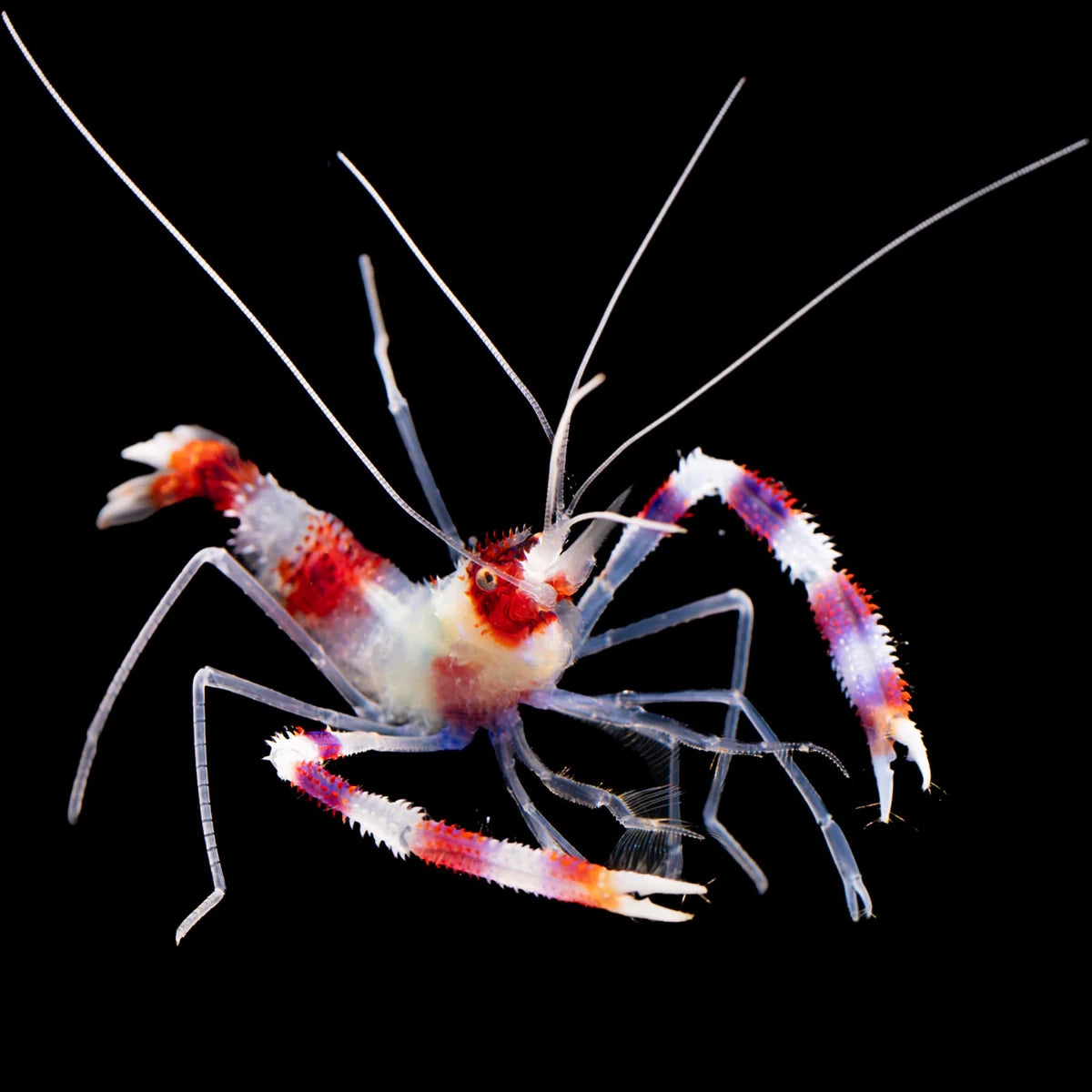
Stenopus hispidus
Banded Coral Shrimp
Banded Coral Shrimp
SKU:I-SHR-001
In stock
Couldn't load pickup availability
 Easy
Easy
 Semi-Aggressive
 Reef Safe

Quick Information
Quick Information
- Care Level: Easy
- Reef Compatible: Reef Safe
- Temper: Semi-Aggressive
- Minimum Tank Size:
The Banded Coral Shrimp catches the eyes of most aquarists with their beautiful coloration and body shape. It has striking red and white bands across its body with fairly long pinchers and extra long white antennae. Combined with its prickly body texture, this peaceful member of the Stenopodidae family brings interest to any marine aquarium. However, most hobbyists praise Stenopus hispidus for its active nature as it scampers around the aquarium in search of food.
Interestingly, members of the Stenopodidae family are known as "Boxing Shrimp" because of the large pinchers on their third set of legs. These pinchers are often held erect and give the Banded Coral Shrimp the appearance of a boxer ready to fight. Though the Banded Coral Shrimp can be aggressive towards other Banded Coral Shrimp and smaller shrimp of different species, most are peaceful towards fish, corals, and invertebrates within your aquarium. Because of its aggressive disposition towards other Banded Coral Shrimp, the Banded Coral Shrimp should be housed individually or kept as a true mated pair.
Native to the oceans of Indonesia, Stenopus hispidus is perhaps the most widely distributed shrimp in the sea. It usually hangs upside-down in caves or crevices, with only its antennae emerging from the hole. While molting, the Banded Coral Shrimp will often hide from sight for 1-2 days in the rocks of the reef. In the home aquarium, provide sufficient room for the Banded Coral Shrimp so it can move about freely without its long antennae touching neighboring corals or anemones.
The Banded Coral Shrimp is relatively hardy and boasts an aquarium-suited length that rarely exceeds 3 inches, 6 inches with the antennae. The male Banded Coral Shrimp is usually smaller. Breeding the Banded Coral Shrimp is usually not successful. Larvae generally succumb to filtration and skimming.
Like other invertebrates, the Banded Coral Shrimp is intolerant of high nitrate or copper levels. Be sure to maintain proper iodine levels in the aquarium to help ensure proper molting. The Banded Coral Shrimp must be acclimated slowly to avoid any salinity and/or pH shock.
In the wild, the Banded Coral Shrimp is a scavenger. In the home aquarium, it will accept most flaked and frozen foods.