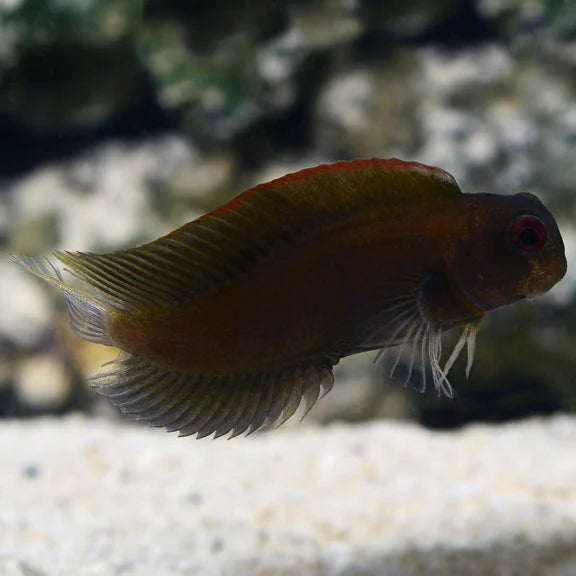
Atrosalarias fuscus
Black Sailfin Blenny
Black Sailfin Blenny
SKU:F-BLN-005
Out of stock
Couldn't load pickup availability
 Easy
Easy
 Peaceful
 With Caution

The Black Sailfin Blenny is prized for its voracious appetite for nuisance microalgae. But the Black Sailfin Blenny is most recognizable for its stark black coloration on both body and fins. Since the Black Sailfin Blenny eagerly perches upon live rock to feed, Atrosalarias fuscus truly creates an eye-catching addition to any saltwater reef system.
Native to the reefs of Java, the Black Sailfin Blenny requires ample live rock with microalgae growth on which it can forage for food. This member of the Blenniidae family is an obligate microalgae eater, which means it needs microalgae in its diet in order to survive. However, its diet can be supplemented with vegetable matter, including frozen and dried foods containing marine and blue-green algae (spirulina).
For the best care, house the Black Sailfin Blenny in an aquarium of at least 30 gallons. The Black Sailfin Blenny likes to hide amongst rockwork and inside caves, so offer a variety of locations in which the Black Sailfin Blenny can find solitude. When properly cared for, this species of Atrosalarias will consume mass amounts of hair or string algae. The Black Sailfin Blenny is peaceful towards tankmates of similar size and temperament. It may nip at some small polyp stony corals and clam mantles, however. Also, the Black Sailfin Blenny may be territorial towards its own species; therefore, if incorporating more than one Black Sailfin Blenny into an aquarium, it is best to acclimate them simultaneously.
The Black Sailfin Blenny is also known as the Dusky Blenny, Brown Coral Blenny, Black Blenny, Highfin Blenny, or Brown Combtooth Blenny. Males are generally larger than females and experience a succession of color changes when breeding.