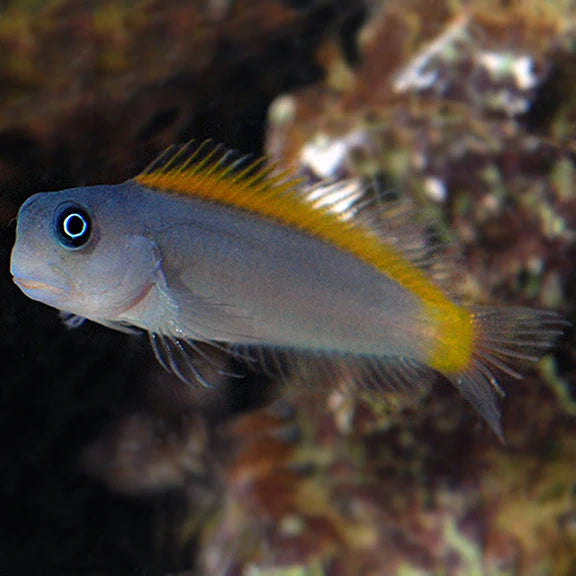
Ecsenius lividanalis
Blue and Gold Blenny
SKU:F-BLN-006
Out of stock
Couldn't load pickup availability
Easy
Peaceful
Reef Safe
The Blue and Gold Blenny originate from the Indo-Pacific, and is a peaceful blenny for a community or reef aquarium. There are two color forms of Ecsenius lividanalis. One form has a blue head, yellow body and a yellow iris. The form that we are offering is referred to as the Dusky form. They are pale blue in color with a yellow dorsal fin and tail. Their iris is pale blue to white in coloration. Both variants share a common black anal spot. They are a comical addition to the marine aquarium that spends much of its time out in the open hopping and perching from one location to another.
The Blue and Gold Blenny is a perfect candidate for the reef aquarium and is considered reef safe but may nip at the polyps or bases of Acropora sp. and other SPS corals. If the SPS dominated aquarium is not heavily stocked with mature colonies these fish may damage Acropora sp. and Montipora sp. in these displays.
Generally found amid crevices and rocks on the bottom of its environment, the Black and Yellow Blenny needs a tank of at least 30 gallons with plenty of scattered live rock for perching and hiding. They are generally peaceful, but may become territorial towards others within the same genus.
The diet of the Blue and Gold Blenny should include meaty items such as vitamin enriched brine and mysis shrimp, chopped fish and shrimp, and a quality flake or pellet food.
Share

Warrning!
Please note that livestock is available for delivery within Jordan only and cannot be shipped internationally due to shipping regulations and animal welfare requirements. For more information, please refer to our Shipping Policy.
Blog posts
View all-
Ich vs. Marine Velvet: How to Recognize and Tre...
Wesam MsaitefLearn how to distinguish marine ich from velvet, recognize the early warning signs, understand why breathing changes matter, and choose an effective treatment approach without exposing your reef tank’s corals...
Ich vs. Marine Velvet: How to Recognize and Tre...
Wesam MsaitefLearn how to distinguish marine ich from velvet, recognize the early warning signs, understand why breathing changes matter, and choose an effective treatment approach without exposing your reef tank’s corals...
-
How to Photograph Corals with Your Smartphone
Wesam MsaitefA Complete Guide to Better Colors, Sharper Details, and More Realistic Reef Photography Introduction Why Does Your Coral Look Amazing in Person but Terrible on Your Phone? You are standing...
How to Photograph Corals with Your Smartphone
Wesam MsaitefA Complete Guide to Better Colors, Sharper Details, and More Realistic Reef Photography Introduction Why Does Your Coral Look Amazing in Person but Terrible on Your Phone? You are standing...
-
Live Rock Buyer's Guide: Live vs. Dry Rock, Cur...
Wesam MsaitefA practical live rock buyer's guide covering live, dry, and man-made rock, curing die-off, common hitchhikers, and aquascaping so your reef tank foundation is right the first time. Introduction Choosing...
Live Rock Buyer's Guide: Live vs. Dry Rock, Cur...
Wesam MsaitefA practical live rock buyer's guide covering live, dry, and man-made rock, curing die-off, common hitchhikers, and aquascaping so your reef tank foundation is right the first time. Introduction Choosing...