Holacanthus bermudensis
Blue Angelfish
Blue Angelfish
SKU:F-ANG-022
Out of stock
Couldn't load pickup availability
Medium
Semi-Aggressive
With Caution
Quick Information
Quick Information
- Care Level: Medium
- Reef Compatible: With Caution
- Temper: Semi-Aggressive
- Minimum Tank Size: 900 Liters
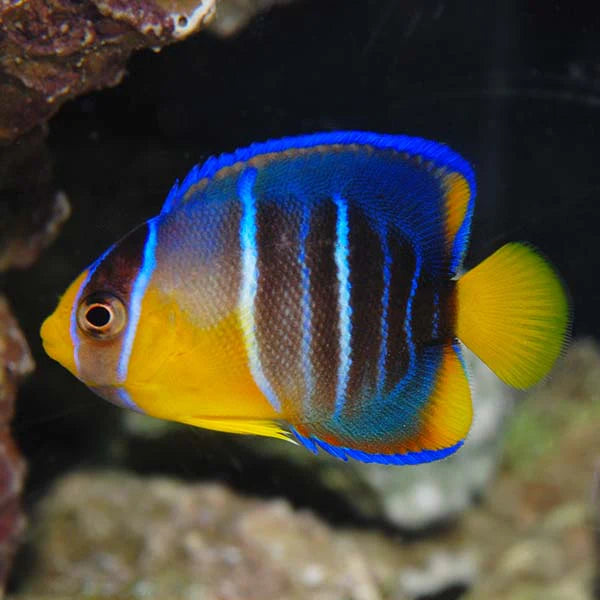
The Blue Angelfish may also be referred to as the Common Angelfish. Similar to the Queen Angelfish, the Blue Angelfish has an overall aqua hue with a yellow shimmer and yellow edges on the fins and scales. The Blue Angelfish does not have the striking blue crown or other blue highlights of the Queen Angelfish. The juvenile Blue Angelfish differs markedly in coloring from the adult, with a yellowish-brown body color and pale blue striping.
The Blue Angelfish requires a large aquarium of at least 250 gallons with plenty of hiding places. Tending towards aggression, especially directed at other angels, the Blue Angelfish is best kept as the only angelfish in the tank. Not a good reef dweller, the Blue Angelfish is prone to nip at stony and soft corals (sessile invertebrates) and clam mantles.
It is hermaphroditic, very difficult to breed in an aquarium, and there are no distinguishing markings that differentiate males from females.
The diet of the Blue Angelfish should include Spirulina, marine algae, high-quality angelfish preparations, mysis or frozen shrimp, other meaty items, and live rock for grazing.
The Small Juvenile will contain the Juvenile colorations or may be color shifting to a young adult, while the Medium will be a sub-adult, and the Large will be in Adult coloration.
Share

Warrning!
Please note that livestock is available for delivery within Jordan only and cannot be shipped internationally due to shipping regulations and animal welfare requirements. For more information, please refer to our Shipping Policy.
Blog posts
View all-
Reef Tank Cleanup Crew Myths vs. Reality: What ...
Wesam MsaitefThink a cleanup crew replaces water changes? Separate reef tank cleanup crew myths from reality and learn how to stock snails, hermit crabs, and shrimp correctly. Introduction A cleanup crew...
Reef Tank Cleanup Crew Myths vs. Reality: What ...
Wesam MsaitefThink a cleanup crew replaces water changes? Separate reef tank cleanup crew myths from reality and learn how to stock snails, hermit crabs, and shrimp correctly. Introduction A cleanup crew...
-
Why Captive-Bred Marine Fish Are the Best Choice?
Wesam MsaitefDiscover why captive-bred marine fish are healthier, easier to keep, and more sustainable than wild-caught fish. Learn the real benefits for both your reef aqua…
1 commentWhy Captive-Bred Marine Fish Are the Best Choice?
Wesam MsaitefDiscover why captive-bred marine fish are healthier, easier to keep, and more sustainable than wild-caught fish. Learn the real benefits for both your reef aqua…
1 comment -
Aiptasia Control Options: Choosing the Right So...
Wesam MsaitefDiscover the most effective Aiptasia control methods for reef aquariums, including chemical treatments, biological predators, manual removal, and long-term prev…
Aiptasia Control Options: Choosing the Right So...
Wesam MsaitefDiscover the most effective Aiptasia control methods for reef aquariums, including chemical treatments, biological predators, manual removal, and long-term prev…