Opistognathus rosenblatti
Blue Dot Jawfish
Blue Dot Jawfish
SKU:F-JAW-001
Out of stock
Couldn't load pickup availability
Medium
Semi-Aggressive
Reef Safe
Quick Information
Quick Information
- Care Level: Medium
- Reef Compatible: Reef Safe
- Temper: Semi-Aggressive
- Minimum Tank Size: 100 Liters
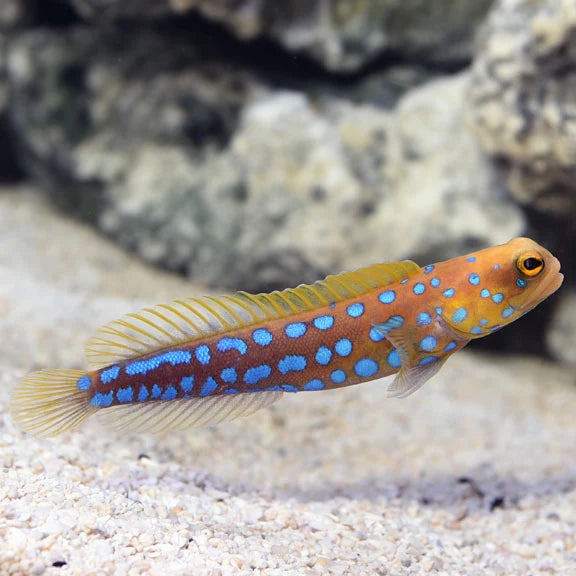
The Blue Dot Jawfish, also known as the Bluespotted Jawfish, was first discovered in the Tropical Eastern Pacific in 1991 by Allen and Robertson. This lively fish boasts bright, flamboyant coloration in contrasting shades of yellows, oranges, and blues with iridescent, irregular-shaped blue spots decorating the entire length of the head and body.
The ideal setup for the Blue Dot Jawfish is an established 30 gallon or larger aquarium with plenty of live rock and a layer of fine to moderately sized sand substrate to sift through. Ample horizontal living space and a substrate layer of at least 3" in depth is necessary for this burrowing fish. In addition, a tight-fitting canopy is necessary to prevent the Blue Dot Jawfish from jumping out of the aquarium. It will rarely become aggressive towards other fish, but is territorial and will fight with its own kind unless they are a mated pair.
The diet of the Blue Dot Jawfish should consist of a variety of marine fish, crustacean flesh, and mysid shrimp. It should be fed at least three times per day.
Share

Warrning!
Please note that livestock is available for delivery within Jordan only and cannot be shipped internationally due to shipping regulations and animal welfare requirements. For more information, please refer to our Shipping Policy.
Blog posts
View all-
Why Captive-Bred Marine Fish Are the Best Choice?
Wesam MsaitefDiscover why captive-bred marine fish are healthier, easier to keep, and more sustainable than wild-caught fish. Learn the real benefits for both your reef aqua…
1 commentWhy Captive-Bred Marine Fish Are the Best Choice?
Wesam MsaitefDiscover why captive-bred marine fish are healthier, easier to keep, and more sustainable than wild-caught fish. Learn the real benefits for both your reef aqua…
1 comment -
Aiptasia Control Options: Choosing the Right So...
Wesam MsaitefDiscover the most effective Aiptasia control methods for reef aquariums, including chemical treatments, biological predators, manual removal, and long-term prev…
Aiptasia Control Options: Choosing the Right So...
Wesam MsaitefDiscover the most effective Aiptasia control methods for reef aquariums, including chemical treatments, biological predators, manual removal, and long-term prev…
-
Common Nuisance Algae and How to Treat Them
Wesam MsaitefLearn how to identify, prevent, and eliminate common nuisance algae in reef aquariums, including diatoms, green hair algae, bryopsis, cyanobacteria, and dinofla…
Common Nuisance Algae and How to Treat Them
Wesam MsaitefLearn how to identify, prevent, and eliminate common nuisance algae in reef aquariums, including diatoms, green hair algae, bryopsis, cyanobacteria, and dinofla…