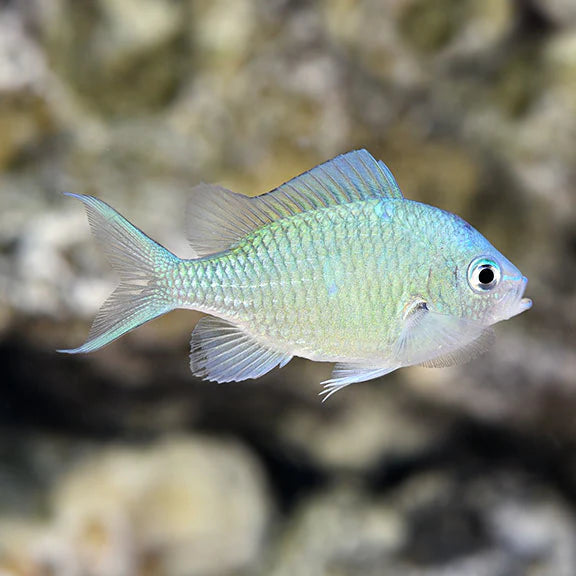
Chromis viridis
Green Reef Chromis
Green Reef Chromis
SKU:F-CMS-002
44 in stock
Couldn't load pickup availability
 Easy
Easy
 Peaceful
 Reef Safe

The Blue Green Reef Chromis is easy to care for, beautiful, and peaceful. In fact, Chromis viridis is one of the preferred marine reef fish amongst aquarists, regardless of their experience level. This member of the Pomacentridae family is most recognizable by its gorgeous light blue dorsal side that slowly fades into a majestic pale green belly. The Blue Green Reef Chromis is desirable not only for its beauty, but also for its peaceful demeanor (despite its designation as a true damselfish) and ability to be kept with almost all other community fish, invertebrates, and corals.
Native to reefs ranging from mid-depth to shallow lagoons of the Indo-Pacific and South Pacific, wild specimens prefer to school in large shoals amongst branching corals like Acropora. In the home aquarium, the Blue Green Reef Chromis does best in similar environments and will actively swim at all levels of the aquarium water column. In fact, a small school of Blue Green Reef Chromis comprised of at least six individuals adds a dazzling and dramatic shimmer of beauty to almost any well-established reef system.
Overall, the Blue Green Reef Chromis is very hardy and can live between 8 to 15 years in aquariums with excellent water quality. For best care, feed several times throughout the day with a varied diet of meaty foods, herbivore flakes, and frozen preparations. Vitamin-enriched foods may also help to preserve body colorations.
Some aquarists have successfully bred the Blue Green Reef Chromis in the home aquarium. Interestingly, the body color of mature males, ready to nest, changes to a muted yellow color. However, breeding success requires perfect water parameters in only the largest of non-predatory aquarium systems.