Bluespotted Angelfish

Description

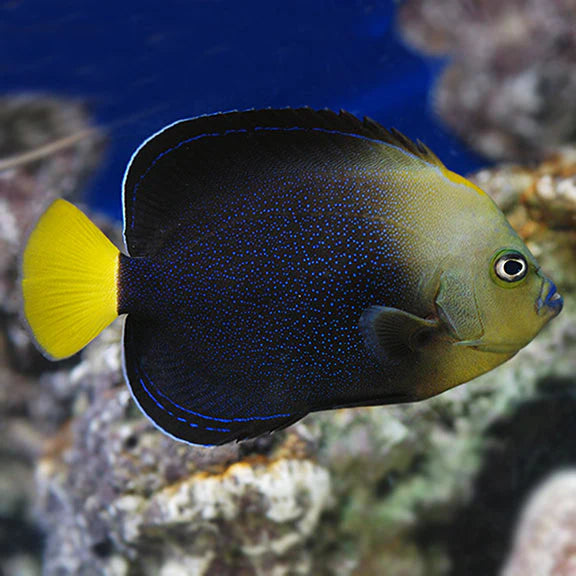
The Bluespotted Angelfish, also known as the Blue-spangled Angelfish, is blue to yellow-brown and covered with small blue dots. It has a bright yellow tail.

It requires a 125 gallon or larger well-established aquarium with numerous hiding places and large amounts of live rock for grazing. It is generally not overly aggressive and should be kept with nonaggressive tankmates. It may nip at soft corals, stony corals, and mantles of tridacnid clams.

The Bluespotted Angelfish will eat filamentous algae and diatoms, and should be fed Spirulina, marine algae, high-quality angelfish preparations, mysid or frozen shrimp, and other meaty items at least three times a day.
Product form

SKU: F-ANG-026

Scientific Name: Chaetodontoplus caeruleopunctatus

The Bluespotted Angelfish, also known as the Blue-spangled Angelfish, is blue to yellow-brown and covered with small blue dots. It... Read more

Sold Out

75.000 JD

    • Care Level: Medium - Hard
    • Reef Compatible: With Caution
    • Temper: Semi-Aggressive
    • Minimum Tank Size: 450 Liters

      This item cant be shipped internationally

    Livestock, including fish, corals, and other aquatic species, cannot be shipped internationally due to shipping and regulatory restrictions.
    Read more

    Description

    The Bluespotted Angelfish, also known as the Blue-spangled Angelfish, is blue to yellow-brown and covered with small blue dots. It has a bright yellow tail.

    It requires a 125 gallon or larger well-established aquarium with numerous hiding places and large amounts of live rock for grazing. It is generally not overly aggressive and should be kept with nonaggressive tankmates. It may nip at soft corals, stony corals, and mantles of tridacnid clams.

    The Bluespotted Angelfish will eat filamentous algae and diatoms, and should be fed Spirulina, marine algae, high-quality angelfish preparations, mysid or frozen shrimp, and other meaty items at least three times a day.

    Important Note
    Proper acclimation is extremely important considering the stress imposed on the animals by the shipping process. Please take a moment to review our Acclimation Guide.


    Recently viewed products

      Login

      Forgot your password?

      Don't have an account yet?
      Create account