Amphiprion ocellaris var.
Mocha Storm Clownfish - Captive-Bred
Mocha Storm Clownfish - Captive-Bred
SKU:F-CLN-008
Out of stock
Couldn't load pickup availability
 Easy
Easy
 Peaceful
 Reef Safe

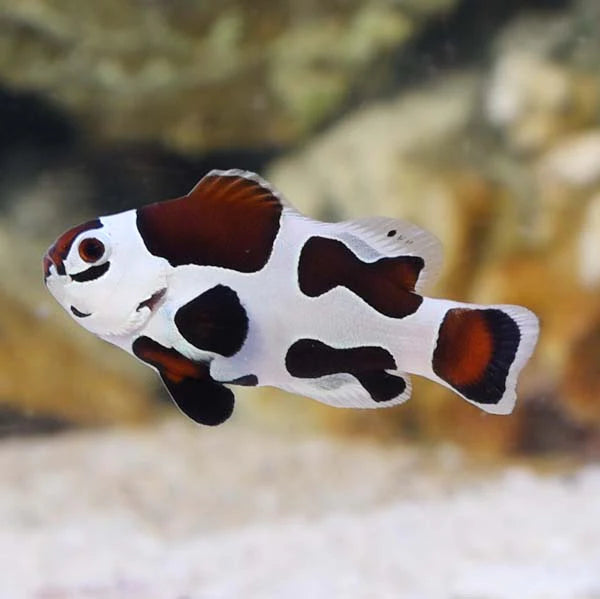
The Captive-Bred Mocha Storm Ocellaris Clownfish is a distinct designer clownfish that derives its lineage from a mutation that appeared during the selective breeding process. The Captive-Bred Mocha Storm Ocellaris Clownfish demonstrates an exaggerated white body pattern with an almost entirely white face with black eyes. The random blotchy patterning of the Captive-Bred Mocha Storm Ocellaris Clownfish sports a lovely orange-brown coloration reminiscent of freshly-brewed sun tea or coffee that is beautifully highlighted by the milk-white coloration.
The Mocha Storm Ocellaris Clownfish does best, housed in an aquarium of at least 20 gallons or larger with plenty of live rock. It may form a symbiotic relationship with the following species of anemones; Carpet (Stichodactyla sp.), Sebae (Heteractis crispa), Bulb (Entacmaea quadricolor), or Ritteri (Heteractis magnifica) Anemones. Though the Mocha Storm Ocellaris Clownfish does not require an anemone to thrive, if you choose to house an anemone, always be sure that your aquarium and lighting system will support the needs of the host anemone before incorporating one into the aquarium.
Captive-Bred Clownfish like the Mocha Storm Ocellaris Clownfish have advantages over wild-harvested species. For one, Captive-Bred Clownfish are very hardy and more accustomed to conditions found in home aquariums. Hence, the Mocha Storm Ocellaris Clownfish makes a great choice for novices and seasoned aquarists alike. The Mocha Storm Ocellaris Clownfish can be kept with a variety of other captive-bred clownfish, if introduced into the aquarium at the same time.
The Mocha Storm Ocellaris Clownfish, like several other captive-bred clownfish, can be bred in the home aquarium with relative ease and is one of the most common "starter" fish for saltwater breeders. The female will be the larger of the pair, and the two fish will usually stay close to each other in the aquarium.
The Mocha Storm Ocellaris Clownfish is an egg layer and will typically deposit the eggs on a flat surface or within the proximity of the base of the host anemone and defend the eggs from other tank mates. The eggs will normally hatch in 6-11 days depending on the temperature. The fry must be reared in a separate aquarium on a diet of rotifers and eventually baby brine shrimp.
The Mocha Storm Ocellaris Clownfish is an omnivore, requiring both meaty foods as well as some greens in their diet. A high-quality marine flake food, rich in spirulina algae, as well as freeze-dried and frozen foods are readily accepted.