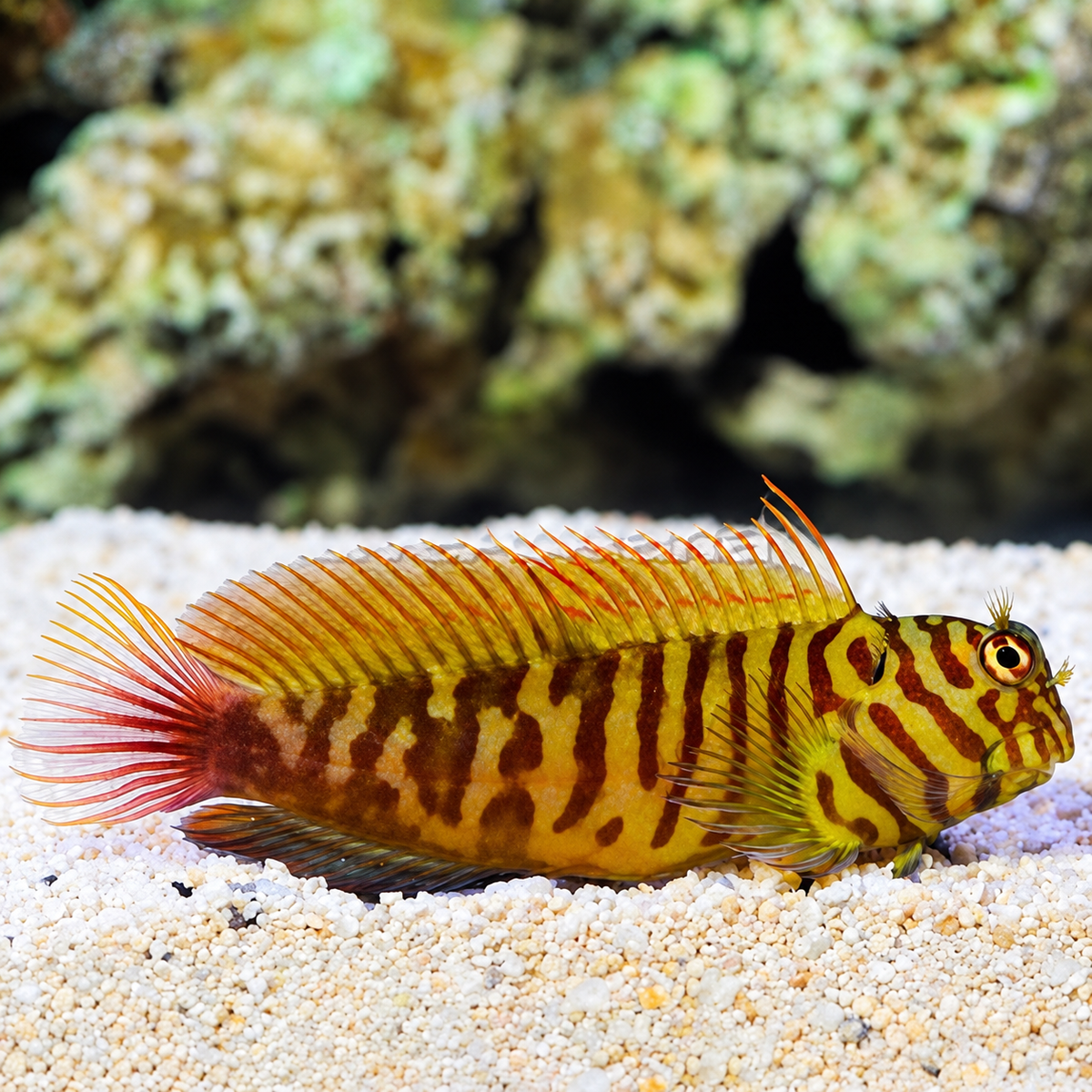
Cirripectes castaneus
Chestnut Blenny
Chestnut Blenny
SKU:F-BLN-038
Low stock: 1 left
Couldn't load pickup availability
 Easy
Easy
 Peaceful
 Reef Safe

The Chestnut Blenny is also known as the Chestnut Eyelash Blenny. Its name comes from its rich chestnut-brown body, which is marked with dark oblique bars edged in red across the head, often continuing along the body as bars or spots. A fringe of fine, reddish cirri (the "eyelashes") crowns the top of the head and eyes, giving this blenny its distinctive, expressive face. Like other blennies, it shows a great deal of personality in the aquarium.
In the wild, the Chestnut Blenny lives on shallow reef crests and surge zones, where it perches among rocks and darts into crevices when approached. It needs a tank of at least 30 gallons with plenty of live rock for perching and hiding, and a tight-fitting lid, as blennies are capable jumpers.
The Chestnut Blenny is a peaceful fish and a good addition to reef aquariums, where it rarely bothers corals. It may, however, be territorial toward other blennies or similarly shaped fish, so it is best kept singly. Avoid housing it with aggressive tankmates.
The diet of the Chestnut Blenny should be based on vegetable matter, including frozen and dried foods containing marine and blue-green algae. A mature tank with natural algae growth is ideal, and it will graze on (and help control) nuisance algae in the aquarium.