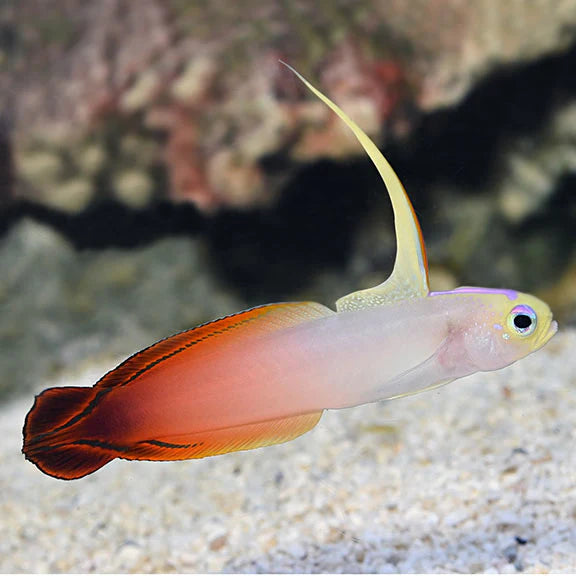
Nemateleotris magnifica
Firefish Goby
Firefish Goby
SKU:F-DRT-002
Low stock: 9 left
Couldn't load pickup availability
 Easy
Easy
 Peaceful
 Reef Safe

Firefish Goby
Firefish Goby – Nemateleotris magnifica
The Firefish Goby, scientifically known as Nemateleotris magnifica, is one of the most popular marine fish among reef aquarium hobbyists thanks to its brilliant coloration, peaceful temperament, and elegant body shape. It is also commonly known as the Fire Goby, Magnificent Firefish, or Fire Dartfish.
This beautiful species features a golden-yellow head that transitions into a white forebody, while the rear half gradually changes to pinkish or orange-red. Its dorsal, anal, and caudal fins are highlighted with black accents, and the elongated dorsal fin gives the fish a graceful appearance while swimming.
In the wild, Firefish Gobies are often found hovering above coral reefs in small groups, feeding on plankton carried by the current. Each fish maintains a nearby burrow or rocky crevice, retreating instantly whenever danger approaches.
Key Features
- Brilliant coloration combining yellow, white, and red.
- Graceful swimming behavior that adds elegance to any aquarium.
- Extremely peaceful and ideal for community reef tanks.
- Completely reef safe with corals and ornamental invertebrates.
- Excellent choice for small to medium-sized marine aquariums.
Aquarium Requirements
- Minimum Aquarium Size: Approximately 75 liters (20 gallons).
- Provide plenty of live rock with multiple caves and hiding places.
- Moderate water flow and moderate lighting are recommended.
- Requires stable water parameters and a mature aquarium.
- A tightly fitted aquarium lid is essential, as this species is well known for jumping when startled or stressed.
Compatibility & Temperament
| Aggression Level | Very Peaceful |
| Reef Compatibility | Yes |
| Fish Compatibility | Compatible with most peaceful reef fish. May become territorial toward members of its own species, so it is best kept singly or as a bonded pair. |
| Invertebrate Compatibility | Completely safe with corals and ornamental invertebrates. |
Feeding
In the wild, the Firefish Goby feeds primarily on zooplankton and tiny organisms carried by ocean currents.
Recommended foods include:
- Vitamin-enriched Mysis Shrimp.
- Vitamin-enriched Brine Shrimp.
- Frozen marine foods.
- High-quality marine pellets and flakes.
- Zooplankton-based foods whenever available.
Feed two to three times daily with a varied diet to maintain vibrant coloration and excellent health.
Reefamorous Tip: Firefish Gobies are shy by nature and feel most secure when provided with multiple hiding places among live rock. Always use a tightly fitting lid, as they are exceptional jumpers even through small openings.