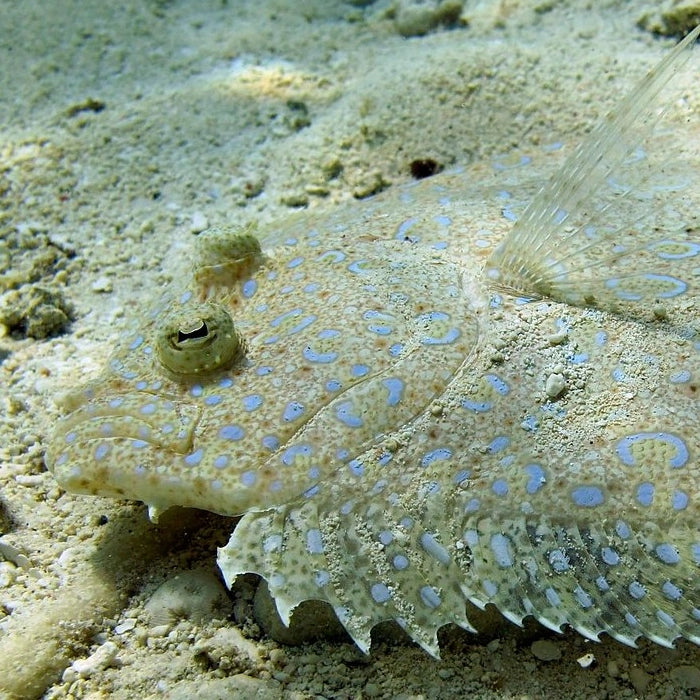
Bothus lunatus
Flounder
Flounder
SKU:F-MSC-004
Out of stock
Couldn't load pickup availability
 Medium
 Semi-Aggressive
 With Caution

Peacock Flounder
Peacock Flounder – Bothus lunatus
The Peacock Flounder, scientifically known as Bothus lunatus, is also commonly referred to as the Plate Fish or simply Flounder. It is one of the most fascinating marine fish due to its flattened body and remarkable camouflage abilities. Resting on one side of its body, this species undergoes a unique transformation during early development, with both eyes migrating to the same side of the head, allowing it to remain hidden while keeping a watchful eye on its surroundings.
Its body is typically brown to gray, decorated with beautiful light blue spots. The Peacock Flounder can rapidly change its coloration to blend seamlessly with sand and the aquarium floor, making it surprisingly difficult to spot despite its size.
Key Features
- Exceptional camouflage abilities that allow it to blend into the substrate.
- Unique flattened body unlike most marine fish.
- Beautiful blue spots become especially striking when fully visible.
- Calm and fascinating behavior for aquarists seeking unusual species.
- Adds remarkable diversity to large marine aquariums.
Aquarium Requirements
- Minimum Aquarium Size: Approximately 475 liters (125 gallons).
- Requires a soft sandy substrate for burrowing and camouflage.
- Provide open sand areas along with some live rock for shelter.
- Needs stable water quality and efficient filtration.
Compatibility & Temperament
| Aggression Level | Predatory but peaceful |
| Reef Compatibility | With caution |
| Invertebrate Compatibility | May consume small fish, shrimp, crabs, and other invertebrates that can fit into its mouth. |
| Fish Compatibility | Compatible with larger marine fish that are too large to be considered prey. |
The Peacock Flounder is generally peaceful toward fish it cannot swallow, but it is an opportunistic ambush predator. It is not suitable for aquariums housing small ornamental fish, shrimp, or other small invertebrates that may eventually become food.
Feeding
The Peacock Flounder requires a protein-rich marine diet to maintain healthy growth and natural hunting behavior.
Recommended foods include:
- Pieces of marine fish.
- Shrimp.
- Krill.
- Clams and other shellfish.
- High-quality frozen foods formulated for predatory marine fish.
Reefamorous Tip: During the acclimation period, use feeding tongs to present food close to the fish, especially if it remains buried beneath the sand. This helps ensure it receives adequate nutrition until it becomes comfortable feeding in the aquarium.