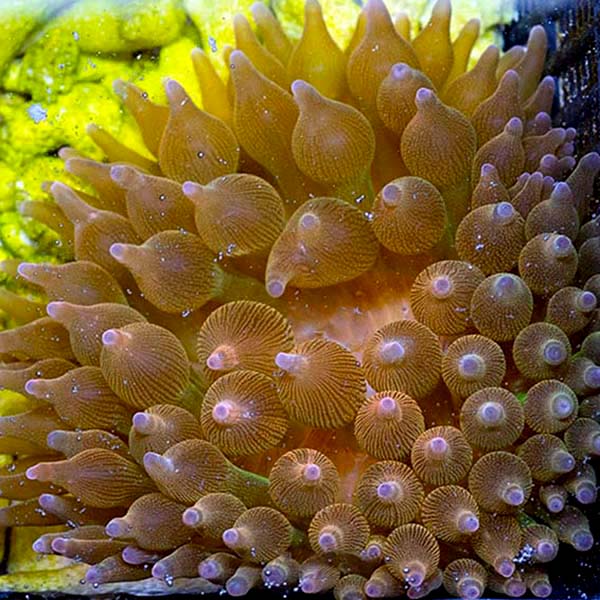
Entacmaea quadricolor
Grade B Rose Bubble Tip Anemone
Grade B Rose Bubble Tip Anemone
SKU:I-ANM-003
In stock
Couldn't load pickup availability
 Medium
 Semi-Aggressive
 With Caution

Quick Information
Quick Information
- Care Level: Medium
- Reef Compatible: With Caution
- Temper: Semi-Aggressive
- Minimum Tank Size: 100 Liters
The Grade B Rose Bubble Tip Anemone is an exceptional color variety of the Bubble Tip Anemone also known as the Four-colored, Bulb Tentacle, Bulb Tip, or Bubble Tip Anemone. The Grade B Rose Bubble Tip Anemone sports an eye-catching combination of red, pink, and green coloration that gives it a fuller, "3-dimensional" appearance sure to make an impressive presentation in your marine aquarium landscape. As its name implies the Grade B Rose Bubble Tip Anemone possesses tentacles with enlarged, bubble-like tips that provides additional visual interest to this colorful anemone.
In the wild, Bubble Tip Anemones are typically found in coral rubble, or in solid reefs with their pedal disc attached deep within these rocky structures. When hungry, the Bubble Tip Anemone stretches its tentacles to increase its chances of capturing a meal. When satiated and content, the tentacles shorten and return to its bulbous shape.
For best care, the Grade B Rose Bubble Tip Anemone should be housed in a large, established aquarium system with high water quality achieved through strong filtration and efficient protein skimming. Employ powerheads or wavemakers to provide moderate or medium water movement. An aquarium of at least 30 gallons in size is essential as the Grade B Rose Bubble Tip Anemone can grow up to 12" across in diameter. Consider a larger, more spacious system if you are planning to house the Grade B Rose Bubble Tip Anemone with fish or in a mixed reef system.
The Grade B Rose Bubble Tip Anemone hosts photosynthetic, symbiotic zooxanthellae algae within its body. Therefore, moderate to high lighting conditions achieved by T-5 fluorescent, powerful LED, or more intense metal halide light fixtures is a must to maintain continued health, bright coloration and its bulbous tips.
Under intense lighting conditions, the Grade B Rose Bubble Tip Anemone will typically remain compact, maintaining its bulbous tips. However, if the lighting is insufficient, the Grade B Rose Bubble Tip Anemone will expand its entire body, stretching out to make the most of the available light. At times, the tentacles may appear stringy; this may be due to insufficient light or the need for food.
Use gloves and handle this invertebrate, and all Anemones, with care. They can sting other anemones, as well as corals.
The diet of the Grade B Rose Bubble Tip Anemone should include chopped fish, shrimp, worms or other meaty items.