Exallias brevis
Leopard Blenny
Leopard Blenny
SKU:F-BLN-018
Out of stock
Couldn't load pickup availability
Expert
Peaceful
Not Reef Safe
Quick Information
Quick Information
- Care Level: Expert
- Reef Compatible: Not Reef Safe
- Temper: Peaceful
- Minimum Tank Size: 100 Liters
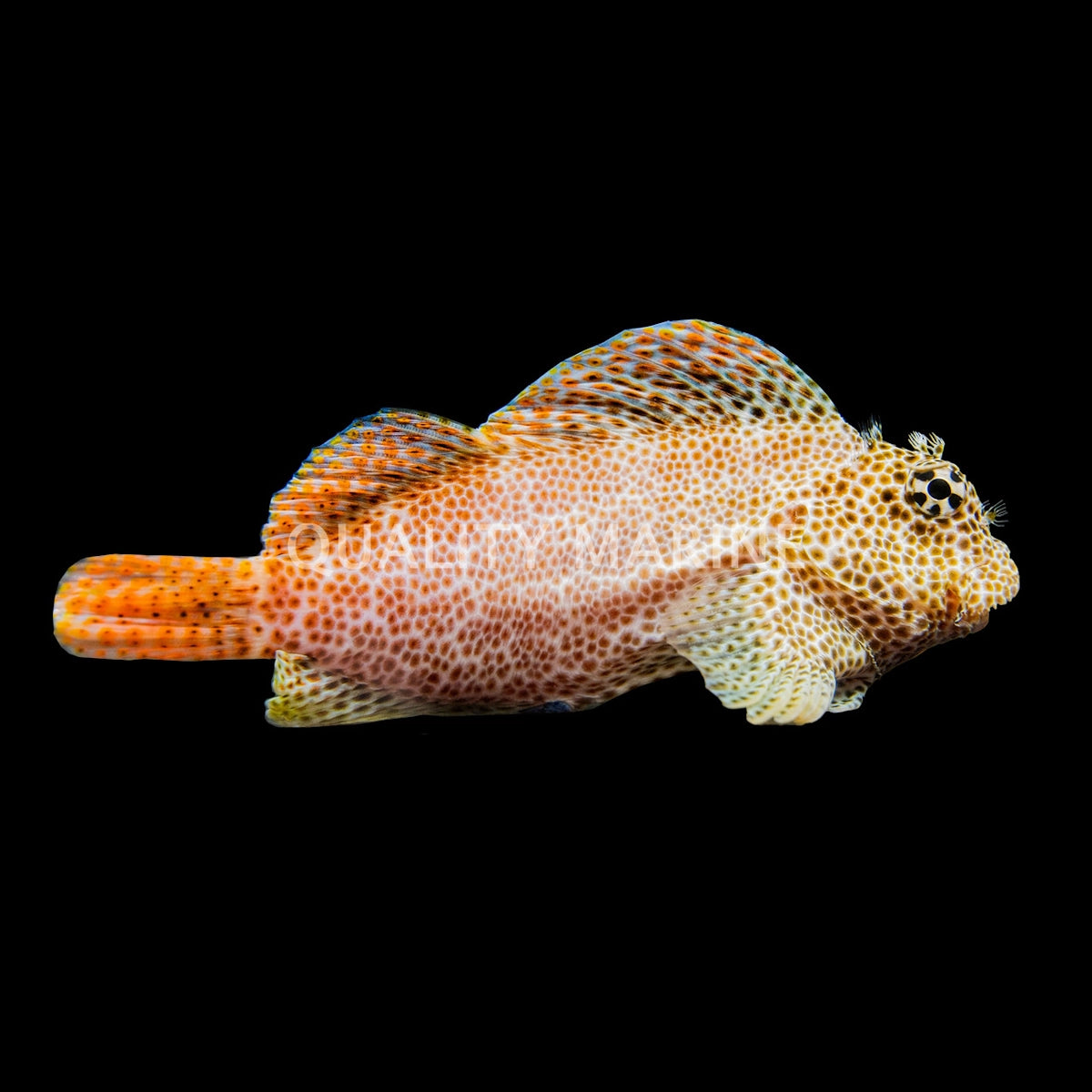
The Leopard Blenny Exallias brevis has a large oblong shaped body with a long dorsal fin that tapers down to its smaller caudal tail. This marine fish goes by a number of different names including Pink Spotted Blenny, Short Bodied Blenny, Leopard Rockskipper, Shortbodied Blenny, Sailfin Blenny, and Honeycomb Blenny. It has an unusual look, from the cirri at the bottom of its head to the tentacle located above each eye. Half of its body is white and the other half is orange, and there are small brown spots appearing across its entire body and fins.
In the aquarium, this marine fish requires plenty of places to hide, like in live rock, and a large area in which to swim. It has an ungainly swim pattern and at times appears to ‘walk’ along the substrate.
This member of the Blenniidae family is not reef safe and requires the care of an expert aquarist to keep it fed. Part of the Toothcomb Blenny group, it has teeth that are configured in a way that allows it to efficiently eat live stony coral polyps. It also uses these teeth to scrape algae off dead corals. Some aquarists try to entice this Blenny to eat occasional frozen or flake herbivore food, finely chopped crustacean flesh, and brine and Mysis shrimp. But if unsuccessful, the aquarist should be prepared to provide stony coral polyps throughout its life.
Share

Warrning!
Please note that livestock is available for delivery within Jordan only and cannot be shipped internationally due to shipping regulations and animal welfare requirements. For more information, please refer to our Shipping Policy.
Blog posts
View all-
Reef Tank Cleanup Crew Myths vs. Reality: What ...
Wesam MsaitefThink a cleanup crew replaces water changes? Separate reef tank cleanup crew myths from reality and learn how to stock snails, hermit crabs, and shrimp correctly. Introduction A cleanup crew...
Reef Tank Cleanup Crew Myths vs. Reality: What ...
Wesam MsaitefThink a cleanup crew replaces water changes? Separate reef tank cleanup crew myths from reality and learn how to stock snails, hermit crabs, and shrimp correctly. Introduction A cleanup crew...
-
Why Captive-Bred Marine Fish Are the Best Choice?
Wesam MsaitefDiscover why captive-bred marine fish are healthier, easier to keep, and more sustainable than wild-caught fish. Learn the real benefits for both your reef aqua…
1 commentWhy Captive-Bred Marine Fish Are the Best Choice?
Wesam MsaitefDiscover why captive-bred marine fish are healthier, easier to keep, and more sustainable than wild-caught fish. Learn the real benefits for both your reef aqua…
1 comment -
Aiptasia Control Options: Choosing the Right So...
Wesam MsaitefDiscover the most effective Aiptasia control methods for reef aquariums, including chemical treatments, biological predators, manual removal, and long-term prev…
Aiptasia Control Options: Choosing the Right So...
Wesam MsaitefDiscover the most effective Aiptasia control methods for reef aquariums, including chemical treatments, biological predators, manual removal, and long-term prev…