Heniochus monoceros
Masked bannerfish
Masked bannerfish
SKU:F-BTF-015
Low stock: 2 left
Couldn't load pickup availability
Medium
Peaceful
With Caution
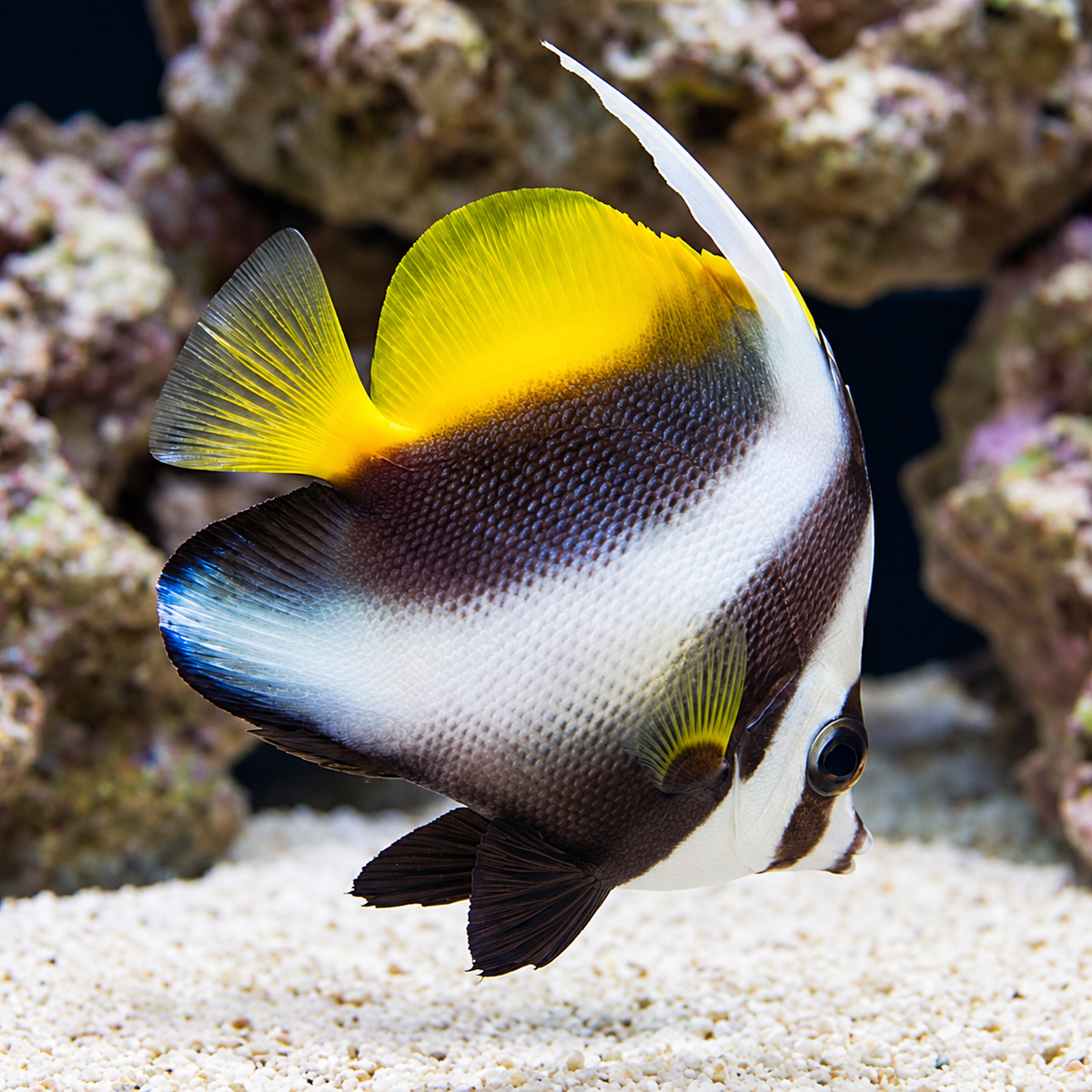
The Masked Bannerfish is also known as the Masked Heniochus, Masked Coachman, or Horned Bannerfish. A member of the butterflyfish family, it has a laterally compressed white body crossed by two bold black bands. The first band covers the face like a mask, running from the mouth over the eyes, while the second crosses the middle of the body. The rear of the body and the dorsal, anal, and caudal fins are bright yellow. The first rays of the dorsal fin stretch into a long white "banner" that grows as the fish matures and trails elegantly as it swims. Adults develop a small hump on the forehead and short horn-like bumps above the eyes, giving this bannerfish its unique look.
In the wild, the Masked Bannerfish lives along reef slopes and coral-rich lagoons, where adults are often seen in pairs. It needs a spacious aquarium of at least 120 gallons with plenty of open swimming room, along with live rock for grazing and shelter.
The Masked Bannerfish is generally peaceful and does well with other non-aggressive fish, though it may be bullied by overly aggressive tankmates. It may squabble with other bannerfish unless they are kept as a pair. Use caution in reef aquariums, since it may nip at soft corals, stony coral polyps, anemones, clams, and other sessile invertebrates, especially when underfed. It is best suited to fish-only aquariums, or reef aquariums with hardy corals.
The diet of the Masked Bannerfish should include a variety of meaty foods, such as frozen mysis shrimp, vitamin-enriched brine shrimp, and finely chopped seafood, along with marine algae and quality flake or pellet foods. It should be fed small portions several times per day.
Share

Warrning!
Please note that livestock is available for delivery within Jordan only and cannot be shipped internationally due to shipping regulations and animal welfare requirements. For more information, please refer to our Shipping Policy.
Acclimation Guide!
A careful acclimation process helps protect new arrivals from sudden changes in temperature, salinity, pH, and other water conditions.
Acclimation Guide.
Blog posts
View all-
Keeping a Reef Tank Cool Through a Riyadh Summer
Wesam MsaitefA practical guide to managing reef aquarium temperature through Riyadh's extreme summer heat — from room AC and cooling fans to dedicated chillers, correct sizing, temperature monitoring, and emergency planning....
Keeping a Reef Tank Cool Through a Riyadh Summer
Wesam MsaitefA practical guide to managing reef aquarium temperature through Riyadh's extreme summer heat — from room AC and cooling fans to dedicated chillers, correct sizing, temperature monitoring, and emergency planning....
-
Ich vs. Marine Velvet: How to Recognize and Tre...
Wesam MsaitefLearn how to distinguish marine ich from velvet, recognize the early warning signs, understand why breathing changes matter, and choose an effective treatment approach without exposing your reef tank’s corals...
Ich vs. Marine Velvet: How to Recognize and Tre...
Wesam MsaitefLearn how to distinguish marine ich from velvet, recognize the early warning signs, understand why breathing changes matter, and choose an effective treatment approach without exposing your reef tank’s corals...
-
How to Photograph Corals with Your Smartphone
Wesam MsaitefA Complete Guide to Better Colors, Sharper Details, and More Realistic Reef Photography Introduction Why Does Your Coral Look Amazing in Person but Terrible on Your Phone? You are standing...
How to Photograph Corals with Your Smartphone
Wesam MsaitefA Complete Guide to Better Colors, Sharper Details, and More Realistic Reef Photography Introduction Why Does Your Coral Look Amazing in Person but Terrible on Your Phone? You are standing...