Turbo fluctuosa
Mexican Turbo Snail
Mexican Turbo Snail
SKU:I-SNL-007
In stock
Couldn't load pickup availability
Easy
Peaceful
Reef Safe
Quick Information
Quick Information
- Care Level: Easy
- Reef Compatible: Reef Safe
- Temper: Peaceful
- Minimum Tank Size:
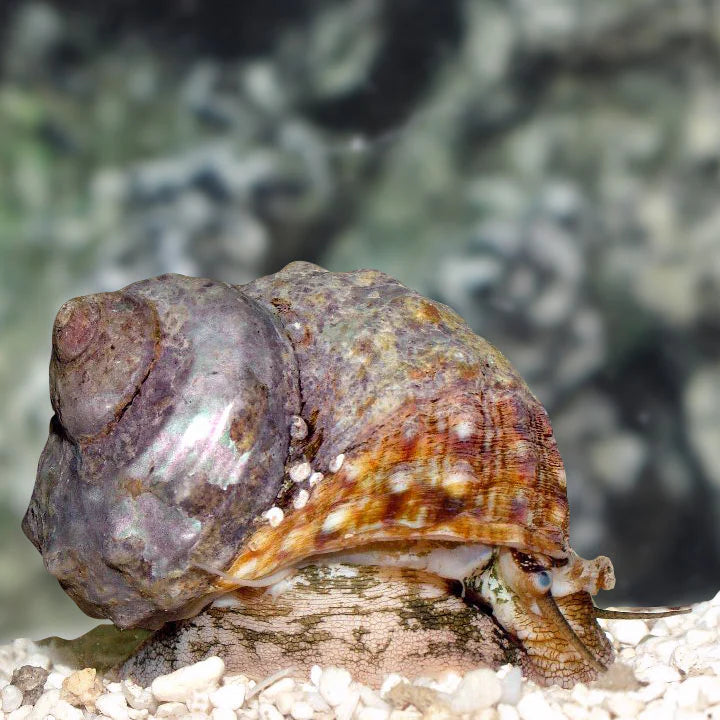
The Turbo Snail is extremely popular among reef aquarium hobbyists, since it quickly eliminates large amounts of nuisance algae. It is particularly fond of hair algae and will consume mass quantities of it and other algae off your live rock and aquarium glass. Also known as the Turban or Top Shell Snail, Turbo fluctuosa has a thick, top- or turban-shaped shell with an irridescent interior. The Turbo Snail is native to the Gulf of California off the coast of Mexico.
An excellent member of your aquarium's cleanup crew, the Turbo Snail thrives in crevices and holes in natural reefs. In the home aquarium, the Turbo Snail needs ample hiding places and large spaces to graze. Some reef aquarists prefer to keep the Turbo Snail in aquariums with well-secured rockwork since this active herbivore is known to bulldoze loose rocks in search of food.
The peaceful Turbo Snail should not be kept with aggressive tankmates that can quickly overcome this slow-moving creature. If algae levels are insufficient, supplement the diet of the Turbo Snail with dried seaweed. Also, adequate calcium levels are required to help this member of the Turbinidae family build its protective shell. Like other invertebrates, the Turbo Snails is very sensitive to copper-based medications and high nitrate levels. To acclimate the Turbo Snail, employ the drip-acclimation method since it is intolerant of even the smallest fluctuations in water parameters.
Share

Warrning!
Please note that livestock is available for delivery within Jordan only and cannot be shipped internationally due to shipping regulations and animal welfare requirements. For more information, please refer to our Shipping Policy.
Blog posts
View all-
Ich vs. Marine Velvet: How to Recognize and Tre...
Wesam MsaitefLearn how to distinguish marine ich from velvet, recognize the early warning signs, understand why breathing changes matter, and choose an effective treatment approach without exposing your reef tank’s corals...
Ich vs. Marine Velvet: How to Recognize and Tre...
Wesam MsaitefLearn how to distinguish marine ich from velvet, recognize the early warning signs, understand why breathing changes matter, and choose an effective treatment approach without exposing your reef tank’s corals...
-
How to Photograph Corals with Your Smartphone
Wesam MsaitefA Complete Guide to Better Colors, Sharper Details, and More Realistic Reef Photography Introduction Why Does Your Coral Look Amazing in Person but Terrible on Your Phone? You are standing...
How to Photograph Corals with Your Smartphone
Wesam MsaitefA Complete Guide to Better Colors, Sharper Details, and More Realistic Reef Photography Introduction Why Does Your Coral Look Amazing in Person but Terrible on Your Phone? You are standing...
-
Live Rock Buyer's Guide: Live vs. Dry Rock, Cur...
Wesam MsaitefA practical live rock buyer's guide covering live, dry, and man-made rock, curing die-off, common hitchhikers, and aquascaping so your reef tank foundation is right the first time. Introduction Choosing...
Live Rock Buyer's Guide: Live vs. Dry Rock, Cur...
Wesam MsaitefA practical live rock buyer's guide covering live, dry, and man-made rock, curing die-off, common hitchhikers, and aquascaping so your reef tank foundation is right the first time. Introduction Choosing...