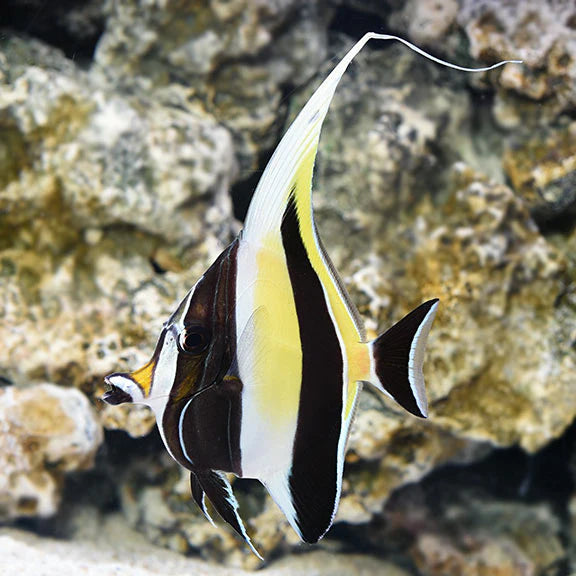
Zanclus cornutus
Moorish Idol EXPERT ONLY
Moorish Idol EXPERT ONLY
SKU:F-MSC-005
Out of stock
Couldn't load pickup availability
 Expert
 Peaceful
 With Caution

Moorish Idol
Moorish Idol – Zanclus cornutus
The Moorish Idol, scientifically known as Zanclus cornutus, is one of the world's most iconic and recognizable marine fish. In Hawaii, it is known as Kihikihi, a name referring to the graceful curves and bold stripes that decorate its body. It is the only living member of the family Zanclidae and is closely related to surgeonfish (tangs).
Its striking appearance features a white body crossed by bold black and yellow bands, complemented by a long ribbon-like dorsal filament that trails elegantly behind it as it swims. Naturally found throughout the Indian Ocean, the Red Sea, and the tropical Pacific, the Moorish Idol is considered one of the most beautiful marine fish in the world.
Key Features
- One of the world's most famous and visually stunning marine fish.
- Long trailing dorsal filament creates an elegant, graceful appearance.
- Beautiful swimming behavior adds exceptional movement to the aquarium.
- Peaceful temperament that is compatible with most marine fish.
- Suitable only for large, well-established marine aquariums.
Aquarium Requirements
- Minimum Aquarium Size: Approximately 475 liters (125 gallons).
- Requires extensive open swimming space.
- Provide abundant live rock rich in natural algae and marine sponges.
- Needs excellent water quality in a mature, stable aquarium.
- Performs best in spacious systems that closely resemble its natural habitat.
Compatibility & Temperament
| Aggression Level | Peaceful |
| Reef Compatibility | No |
| Coral Compatibility | May feed on coral polyps, marine sponges, and certain sessile invertebrates. Not recommended for reef aquariums. |
| Fish Compatibility | Compatible with most peaceful marine fish and larger non-aggressive species. |
The Moorish Idol is best suited for large fish-only or FOWLR aquariums. Due to its specialized feeding habits and sensitivity, it should only be attempted by experienced marine aquarists who can provide an established aquarium with abundant natural food sources.
Feeding
The Moorish Idol is widely regarded as one of the most difficult marine fish to maintain because of its specialized dietary requirements. A highly varied diet and frequent feeding are essential for long-term success.
Recommended foods include:
- Marine algae.
- Spirulina-based foods.
- Frozen Mysis Shrimp.
- Vitamin-enriched Brine Shrimp.
- Finely chopped marine seafood.
- High-quality frozen marine foods.
Reefamorous Tip: Mature live rock containing natural algae and marine sponge growth greatly improves the chances of successful acclimation. Offer several small meals each day and provide a wide variety of foods to encourage consistent feeding.
Care Level
The Moorish Idol is considered one of the most challenging marine fish to keep due to its delicate nature and demanding feeding requirements. It is recommended only for highly experienced marine aquarists. Beginners are generally encouraged to admire this remarkable species in its natural habitat or in public aquariums where its specialized needs can be properly met.