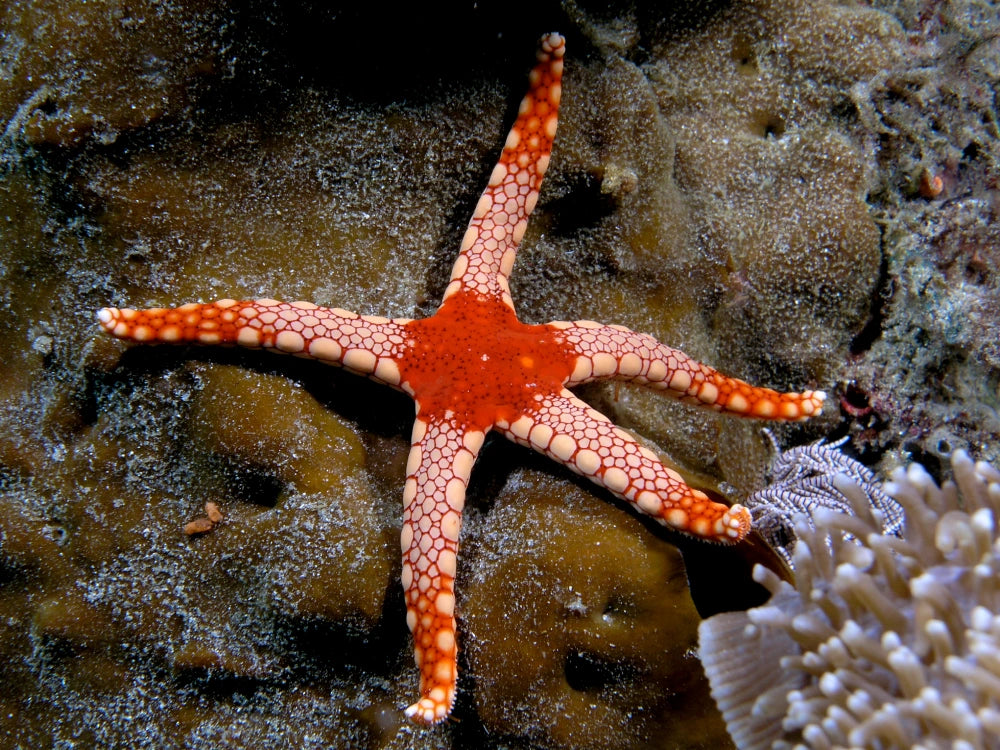
Fromia sp.
Orange Marble Sea Star
SKU:I-STR-003
Out of stock
Couldn't load pickup availability
Expert
Peaceful
Reef Safe
Quick Information
Quick Information
- Care Level: Expert
- Reef Compatible: Reef Safe
- Temper: Peaceful
- Minimum Tank Size:
Scientific Name: Fromia sp.
Fromia Sea Star should be added to well established aquariums with a deep bed of sand and plenty of open area. Fromia Sea Stars are generally found in shallow tropical waters of the Indo-Pacific region including the Red Sea, Indian Ocean and the western and central Pacific Ocean. Invertebrates do not tolerate copper medications and are sensitive to water parameter changes. Fromia sea stars are primarily scavengers and detritivores. They feed on organic matter, algae, and small particles found in the aquarium substrate and on live rock. If natural foods are not available supplement their diet by feeding sinking shrimp pellets and/or small pieces of fish or mussel flesh. Fromia sea stars are generally reef-safe and peaceful, making them suitable for reef aquariums. Fromia sea stars are known for their regenerative abilities. If an arm is injured or damaged, it has the potential to regrow over time, which is a remarkable adaptation for survival.
The Fromia Sea Star is also known as the Orange Marble Sea Star. Not often seen in the aquarium trade. Most often seen with white to off white marbling and orange to burnt orange over all color. Fromia Sea Stars can grow to about 5".
Water conditions: Salinity 1.023 - 1.025 Temp (F) 72 - 78, pH 8.1 - 8.4, Hardness 8 - 12 dKH
Share

Warrning!
Please note that livestock is available for delivery within Jordan only and cannot be shipped internationally due to shipping regulations and animal welfare requirements. For more information, please refer to our Shipping Policy.
Blog posts
View all-
Ich vs. Marine Velvet: How to Recognize and Tre...
Wesam MsaitefLearn how to distinguish marine ich from velvet, recognize the early warning signs, understand why breathing changes matter, and choose an effective treatment approach without exposing your reef tank’s corals...
Ich vs. Marine Velvet: How to Recognize and Tre...
Wesam MsaitefLearn how to distinguish marine ich from velvet, recognize the early warning signs, understand why breathing changes matter, and choose an effective treatment approach without exposing your reef tank’s corals...
-
How to Photograph Corals with Your Smartphone
Wesam MsaitefA Complete Guide to Better Colors, Sharper Details, and More Realistic Reef Photography Introduction Why Does Your Coral Look Amazing in Person but Terrible on Your Phone? You are standing...
How to Photograph Corals with Your Smartphone
Wesam MsaitefA Complete Guide to Better Colors, Sharper Details, and More Realistic Reef Photography Introduction Why Does Your Coral Look Amazing in Person but Terrible on Your Phone? You are standing...
-
Live Rock Buyer's Guide: Live vs. Dry Rock, Cur...
Wesam MsaitefA practical live rock buyer's guide covering live, dry, and man-made rock, curing die-off, common hitchhikers, and aquascaping so your reef tank foundation is right the first time. Introduction Choosing...
Live Rock Buyer's Guide: Live vs. Dry Rock, Cur...
Wesam MsaitefA practical live rock buyer's guide covering live, dry, and man-made rock, curing die-off, common hitchhikers, and aquascaping so your reef tank foundation is right the first time. Introduction Choosing...