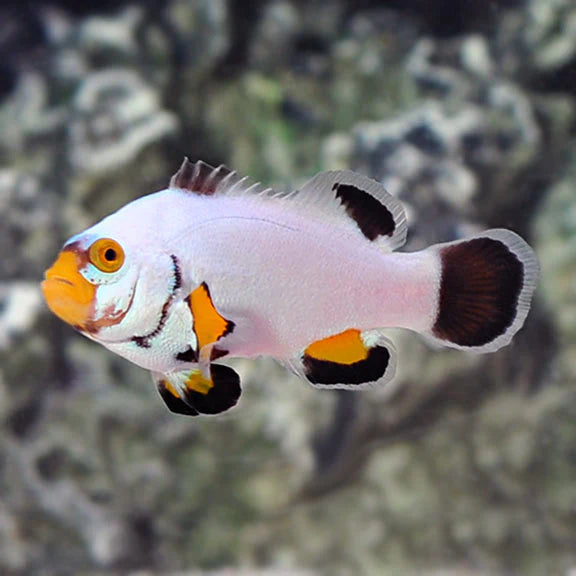
Amphiprion percula
Platinum Clownfish - Captive-Bred
Platinum Clownfish - Captive-Bred
SKU:F-CLN-010
Out of stock
Couldn't load pickup availability
 Easy
Easy
 Peaceful
 Reef Safe

You've never seen a captive-bred clownfish like this before! The Platinum Percula is a magnificent white variation of the Percula Clownfish. developed the Platinum Percula through years of selectively breeding their famous Picasso Clownfish. These striking fish do not exhibit any of the original striping characteristic of the species. Instead, they are typically continuously white from head to tail. As Platinums mature, they will develop beautiful black fins that really stand out against the white body and orange face.
Amphiprion percula is the essence of beauty. However, it is the famous symbiotic relationship the Percula Clownfish has with various anemones that truly captures the imagination of most aquarists. In the wild, Percula Clownfish are commonly associated with anemones such as Heteractis magnifica or Stichodactyla mertensii.
Native to reefs across Oceania, the Indo-Pacific, and off the coast of Australia, the Percula Clownfish is also known as the Clown Anemonefish. In the wild, this member of the Pomacentridae family grows to about 4-1/2 inches; however, captive specimens rarely exceed 3 inches in length. In the home aquarium, the Percula Clownfish requires an aquarium of at least 20 gallons with a fair amount of live rock.
The Captive-Bred Platinum Clownfish is easy to breed in the home aquarium. The females will be the largest of the pair and the two fish will usually stay close to each other in the aquarium. Clownfish are egg layers and will deposit the eggs on a flat surface and defend the eggs from other tank mates. The eggs will normally hatch in 8-11 days depending on the water temperature. The fry must be reared in a separate aquarium on a diet of rotifers followed by baby brine shrimp.
The Platinum Clownfish diet consists of almost any meaty food items and herbivore preparations.