Synchiropus sycorax
RUBY RED DRAGONET
RUBY RED DRAGONET
SKU:F-DRG-001
Out of stock
Couldn't load pickup availability
 Hard
Hard
 Peaceful
 Reef Safe

Ruby Red Dragonet
Ruby Red Dragonet – Synchiropus sycorax
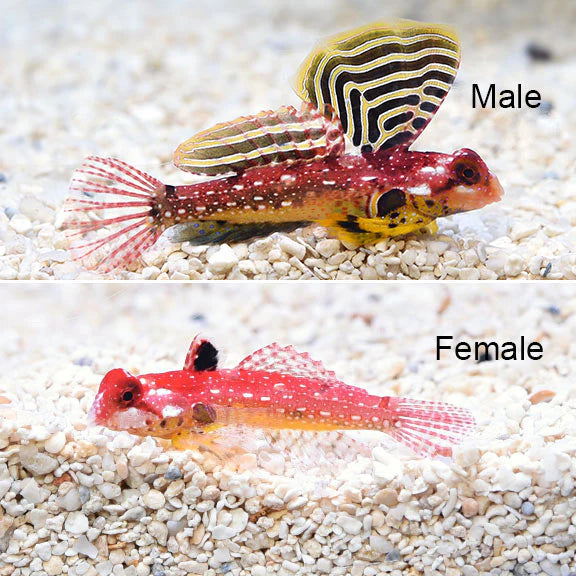
The Ruby Red Dragonet, scientifically known as Synchiropus sycorax, is also commonly referred to as the Ruby Dragonet. Native to the Philippines, it is one of the most beautiful dragonet species, admired for its brilliant ruby-red coloration and intricate natural patterns. As a relatively uncommon species, it adds exceptional beauty and uniqueness to reef aquariums.
This peaceful fish spends most of its time slowly exploring live rock and sandy areas in search of tiny crustaceans and other microscopic prey. Its calm nature and fascinating feeding behavior make it a favorite among experienced reef aquarists.
Key Features
- Brilliant ruby-red coloration with distinctive natural markings.
- Completely reef-safe with corals and invertebrates.
- Peaceful temperament, ideal for community reef aquariums.
- Adds unique beauty and diversity to mature reef systems.
- Thrives in established aquariums rich in natural microfauna.
Aquarium Requirements
- Minimum Aquarium Size: Approximately 115 liters (30 gallons).
- The aquarium should be mature with a large amount of live rock.
- A live sand bed is recommended to support natural food sources.
- Tank mates should be peaceful and should not outcompete it for food.
- When keeping multiple specimens, introduce them all at the same time.
- The ideal ratio is one male with two to three females.
- If keeping more than one male, an aquarium of at least 210 liters (55 gallons) is recommended.
Compatibility & Temperament
| Aggression Level | Very peaceful |
| Reef Compatibility | Yes, completely reef-safe |
| Fish Compatibility | Compatible with most peaceful marine fish |
| Special Considerations | Should not be housed with fast or aggressive feeders that may outcompete it for food. |
The Ruby Red Dragonet is an excellent community reef fish but should only be kept with peaceful tank mates. Because it feeds slowly and deliberately, it can struggle to compete with more aggressive or fast-feeding species. A mature reef aquarium with abundant natural copepods provides the best long-term environment.
Feeding
The Ruby Red Dragonet naturally feeds on tiny crustaceans and other microfauna living among live rock and sand. Supplemental feeding is recommended, particularly in newer aquariums or systems with limited pod populations.
Recommended foods include:
- Vitamin-enriched Brine Shrimp.
- Bloodworms.
- Glassworms.
- Small Frozen Mysis Shrimp.
- Tiny marine invertebrates and other suitable frozen foods.
Reefamorous Tip: A well-established reef aquarium with a thriving population of copepods and other microfauna offers the best chance for long-term success. Because this species feeds slowly, ensure it has adequate access to food without competition from faster tank mates.