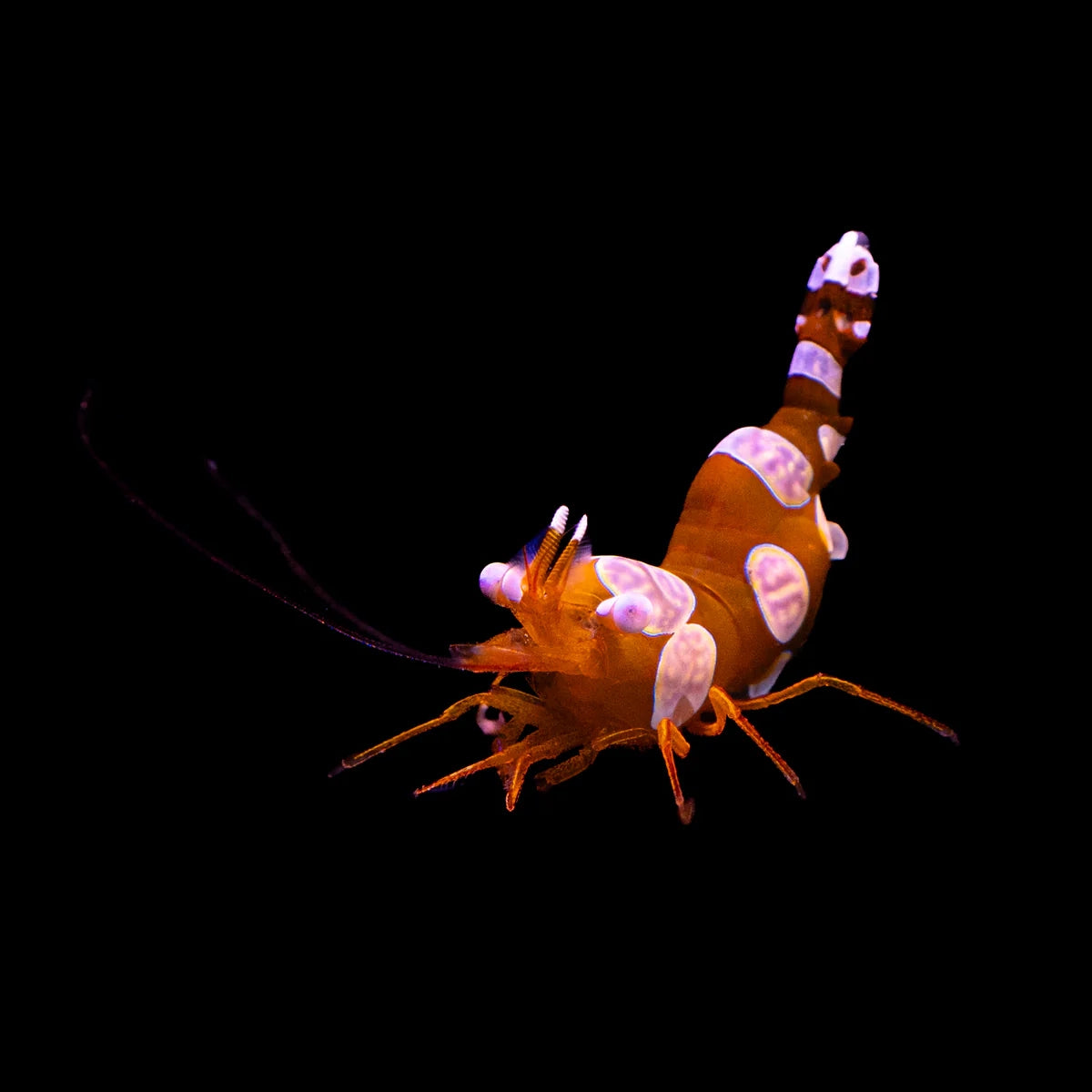
Thor amboinensis
Sexy Anemone Shrimp
Sexy Anemone Shrimp
SKU:I-SHR-008
Low stock
Couldn't load pickup availability
 Easy
Easy
 Peaceful
 Reef Safe

Quick Information
Quick Information
- Care Level: Easy
- Reef Compatible: Reef Safe
- Temper: Peaceful
- Minimum Tank Size:
The Sexy Anemone Shrimp is named for its unusual body movements. When walking, Thor amboinensis sways its abdomen back and forth with exotic flair. In addition to this fascinating behavior, the Sexy Anemone Shrimp is also uniquely dressed in a reddish brown body dotted with brilliant white spots. These characteristics make the Sexy Anemone Shrimps an enchanting aquarium addition.
Native to the reefs of the Indo-Pacific, this member of the Hippolytidae family is usually found amongst the tentacles of an anemone. In the home aquarium, however, the Sexy Anemone Shrimp is often found perched on a coral frag or outcropping of live rock. Most are equally fearless as they are beautiful and will scavenge in any area of the aquarium in search of meaty foods.
For best care, the Sexy Anemone Shrimp should be kept in small groups and fed a varied diet of plankton and flaked, frozen, and meaty foods. It is peaceful towards members of its own species and other tankmates. The Sexy Anemone Shrimp should not be housed in aquariums with predatory fish that might attack these small shrimp.
Interestingly, the Sexy Anemone Shrimp is a relatively fast grower and will molt about once a month. However, most Sexy Anemone Shrimp will grow only to a maximum size of around 1-1/2". Although very hardy, it requires a slow acclimation process to avoid any salinity and/or pH shock. Like other invertebrates, the Sexy Anemone Shrimp cannot tolerate high nitrate or copper levels. To promote proper molting, sufficient iodine levels must be maintained.