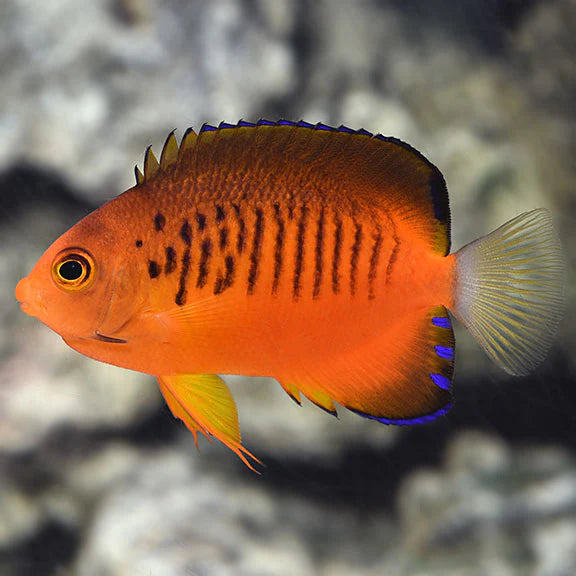
Centropyge shepardi
True Shepard's Angelfish
True Shepard's Angelfish
SKU:F-ANG-017
Out of stock
Couldn't load pickup availability
 Medium
 Semi-Aggressive
 With Caution

The True Shepard’s Angelfish (Centropyge shepardi), also known as the Mango Angelfish, is a dwarf marine angelfish that comes from corals reefs in remote areas of the Western Pacific such as the Mariana Islands, Ogasawara and occasionally the Izu Islands of Japan.
At first glance the True Shepard’s Angelfish may be casually mistaken for the Coral Beauty Angelfish. Though similar in appearance and coloration, the Shepard’s Angelfish features notably less blue and purple coloration distinct to the Coral Beauty Angelfish.
One can argue that the Coral Beauty Angelfish is mostly a blue fish with orange coloration, while the True Shepard’s Angelfish, in contrast, is predominantly an orange fish with blue markings. The majority of the True Shepard’s Angelfish is a vibrant orange and yellow coloration with only a thin perimeter of the back, dorsal, and anal fins sporting a contrasting purple to blue color. Bold vertical bars in a matching blue coloration adorns the upper half of the body.
The True Shepard’s Angelfish is a hardy fish that is typically considered to be a good eater with a hearty appetite. These easy to care for dwarf marine angelfish usually will not bother corals as long as the fish is properly fed and has plenty of live rock to graze on, making the True Shepard’s Angelfish a great candidate for the entry level to advanced aquarist.
True Shepard’s Angelfish can grow to 4” or more so an established 70 gallon aquarium or large setup aquascaped with generous amounts of live rock with plenty of open spaces to swim, is recommended.
The diet of the True Shepard’s Angelfish should consist of enriched frozen brine shrimp, mysis shrimp, spirulina and other prepared quality marine angelfish diets.