Tiger Cowrie

Description

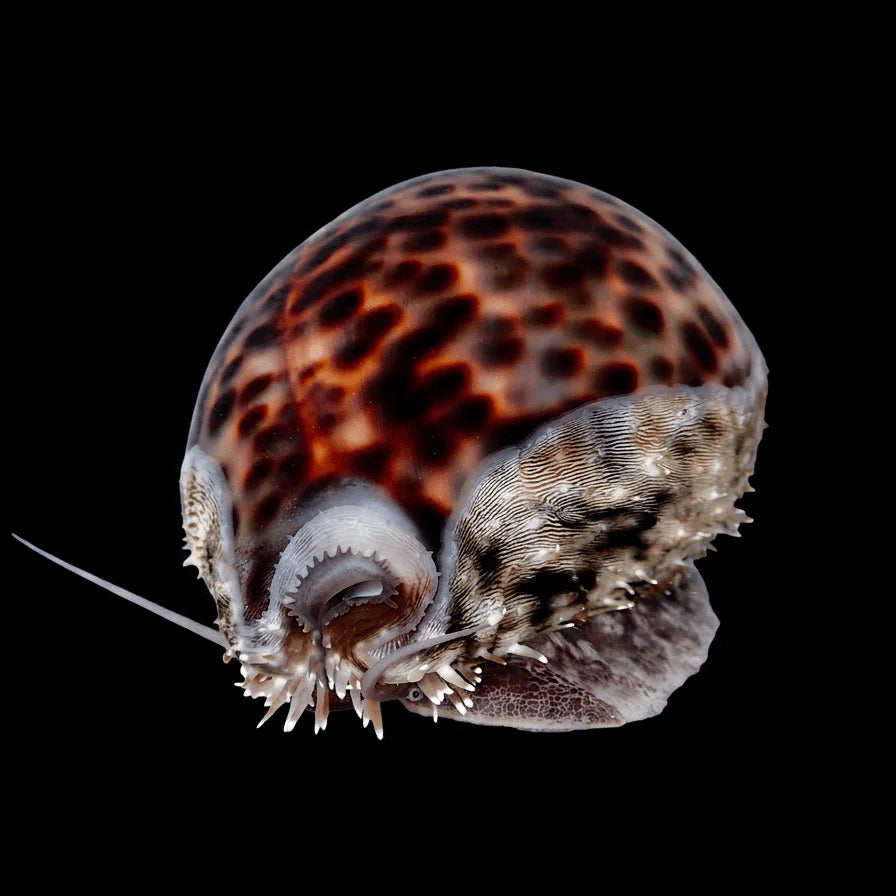
The Tiger Cowrie has an egg-shaped, spotted, glossy shell and is in high demand for the rock aquarium. It differs in color depending upon geographical location. While it does not have an operculum to shut when it retracts its mantle into its shell, the opening is lined with "threatening" tooth-like structures. Normally, the mantle will completely cover its shell unless it feels threatened. This helps it keep its lustrous white and brown mottled coloration, while its mantle will appear like a fingerprint of black and gray, with many short papillae over the surface.

In the wild, it can be found under rocks or resting on soft corals during the day, foraging for food mostly at night. The Tiger Cowrie prefers a rock aquarium with hiding places. While small, it will eat some algae and scavenge for scraps, but as an adult, it will eat some anemones, sponges, and soft corals, and is best housed with starfish, sea urchins, and tubeworms in the reef aquarium. Do not house it with Condylactis sp. It needs low nitrate levels and will not tolerate copper-based medications.

The diet of a large Tiger Cowrie should be supplemented with pieces of fish and mussel.
Product form

SKU: I-SNL-002

Cypraea tigris

The Tiger Cowrie has an egg-shaped, spotted, glossy shell and is in high demand for the rock aquarium. It differs... Read more

Sold Out

10.000 JD

    • Care Level: Easy
    • Reef Compatible: With Caution
    • Temper: Peaceful
    • Minimum Tank Size:

      This item cant be shipped internationally

    Livestock, including fish, corals, and other aquatic species, cannot be shipped internationally due to shipping and regulatory restrictions.
    Read more

    Description

    The Tiger Cowrie has an egg-shaped, spotted, glossy shell and is in high demand for the rock aquarium. It differs in color depending upon geographical location. While it does not have an operculum to shut when it retracts its mantle into its shell, the opening is lined with "threatening" tooth-like structures. Normally, the mantle will completely cover its shell unless it feels threatened. This helps it keep its lustrous white and brown mottled coloration, while its mantle will appear like a fingerprint of black and gray, with many short papillae over the surface.

    In the wild, it can be found under rocks or resting on soft corals during the day, foraging for food mostly at night. The Tiger Cowrie prefers a rock aquarium with hiding places. While small, it will eat some algae and scavenge for scraps, but as an adult, it will eat some anemones, sponges, and soft corals, and is best housed with starfish, sea urchins, and tubeworms in the reef aquarium. Do not house it with Condylactis sp. It needs low nitrate levels and will not tolerate copper-based medications.

    The diet of a large Tiger Cowrie should be supplemented with pieces of fish and mussel.

    Important Note
    Proper acclimation is extremely important considering the stress imposed on the animals by the shipping process. Please take a moment to review our Acclimation Guide.


    Recently viewed products

      Login

      Forgot your password?

      Don't have an account yet?
      Create account