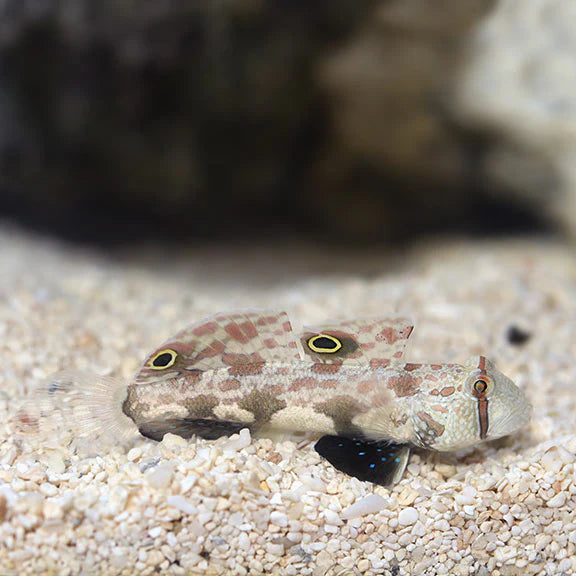
Signigobius biocellatus
Two Spot Goby
Two Spot Goby
SKU:F-GOB-014
Out of stock
Couldn't load pickup availability
 Hard
Hard
 Peaceful
 Reef Safe

Two Spot Goby
Two Spot Goby – Signigobius biocellatus
The Two Spot Goby, scientifically known as Signigobius biocellatus, is also commonly called the Twinspot Goby, Signal Goby, or Crabeye Goby. It is one of the most beautiful sand-sifting gobies, admired for its elegant coloration and its tall dorsal fins decorated with two large eye-like spots that give this species its distinctive appearance.
Its white body is beautifully patterned with orange markings and delicate stripes, while the raised dorsal fins create a dramatic display that makes this goby one of the most eye-catching bottom-dwelling fish for reef aquariums.
Key Features
- Tall dorsal fins decorated with two distinctive eye spots.
- Beautiful white and orange coloration.
- Continuously sifts sand to help maintain a clean substrate.
- Peaceful and completely reef-safe.
- May spawn in the aquarium under suitable conditions.
Aquarium Requirements
- Minimum Aquarium Size: Approximately 40 liters (10 gallons).
- Requires a bed of fine live sand for natural feeding behavior.
- A mature refugium rich in copepods and amphipods is highly recommended.
- Provide live rock and several hiding places.
- Best kept in a mature aquarium with stable water parameters.
Compatibility & Temperament
| Aggression Level | Peaceful |
| Reef Compatibility | Yes |
| Fish Compatibility | Compatible with most peaceful reef fish and rarely displays aggression toward other species. |
| Recommendation | May become territorial toward its own species, so it is best kept singly or as a compatible pair. |
The Two Spot Goby naturally sifts mouthfuls of sand to extract tiny worms, crustaceans, and other microscopic organisms before releasing the cleaned sand back into the aquarium, helping maintain a healthy and well-aerated substrate.
Feeding
This species naturally feeds on tiny organisms found within the sand bed and should receive a varied supplemental diet in captivity.
Recommended foods include:
- Vitamin-enriched Mysis Shrimp.
- Vitamin-enriched Brine Shrimp.
- Live Blackworms.
- Frozen marine foods.
- High-quality pellets formulated for carnivorous marine fish.
Reefamorous Tip: Feed several small meals daily and maintain a mature live sand bed rich in microfauna to ensure successful long-term care and easy acclimation.